Rabban Gamaliel, son of R. Judah the Patriarch, says, “Torah study is commendable when combined with a profession, for the effort of the two together drives away sin. Torah, when not combined with work, inevitably leads to idleness and sin.”
Pirke Avot 2:2a
Torah should not be confined to a vacuum. It should live out in the world, in the workplace, and in places of entertainment. It is most meaningful when it is integrated into one’s life. To be shut away in the confines of the Beit Midrash (House of Study) is to learn Torah that is never challenged by or applied to the larger world. When the learner takes Torah into the workplace and applies to it his or her life, such Torah teachings deeply affect both the learner and the world around.
Ahavas Israel believes that the best way to promote Jewish continuity is to encourage those who engage in Torah both inside and outside the synagogue. We teach and preach a sophisticated Torah. We encourage our members to expose their children to the power of the Torah for adults by coming to Shabbat services, by having weekly Shabbat meals as a family, by considering kashrut when eating both inside and outside the home, by celebrating Festivals inside and outside the synagogue, and by engaging in acts of gemilut hasadim. Torah best infuses your life when you live according to the values and lessons of Torah, even and especially at those times when it is not convenient or comfortable.
Obviously, not every Ahavas Israel family embraces every action on the list above. But being serious about even just one mitzvah has beneficial results. Here is one example, from a family who came to shul with their children from a young age through high school for two or three Shabbat services a month, 12 months a year, as well as sending the children to religious school through 12th grade. The child chooses a college with a very small Jewish population, a handful of Jewish faculty, but no formal Jewish programming. This young person initiated contact with a Hillel outreach professional and created a Jewish presence by bringing Hillel to campus, and took the initiative to plan and lead a Passover Seder. The is the power of the Torah learned by participation in the Ahavas Israel community.
Another example, from a family who came to Shabbat services weekly, ate weekly Shabbat dinners together, kept kosher, and took advantage of our generous Jewish camp scholarship program. Based on a lesson the children learned in Religious school, they began as teens to keep kosher outside of their home. I participated in the weddings of all the children, in whose kosher homes they are now actively passing along Judaism to their children. The more seriously you take Torah, the more powerful the Torah of the Ahavas Israel community can be.
Want to explore Torah at Ahavas Israel? Start with our new monthly Beit Midrash program. For more information, see the article under “upcoming events.”
Hebrew Words of the Month:
- Talmud Torah – Torah study
- Beit Midrash – House of study
- Derekh Eretz – “the way of the land,” variously translated as proper manners or a profession.
- Melakhah – creative work, often referring to prohibited labors on Shabbat.
- Avodah – service or worship, though it an also mean work.
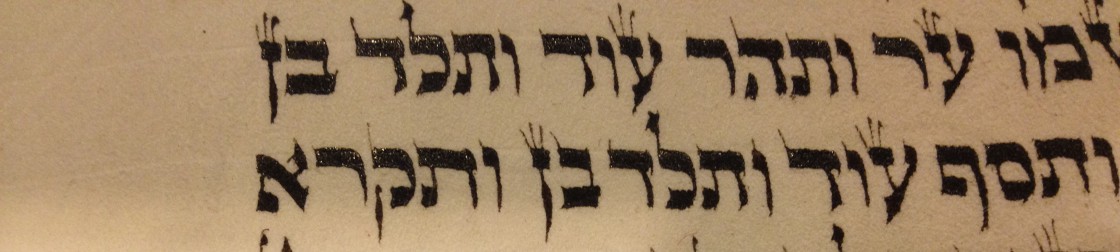
 Embodied Torah