
Welcoming Chaverim, for Developmentally Disabled Adults

Reposted from my friend and colleague Rabbi Paul Kipnes’ Blog:
rabbipaul.blogspot.com
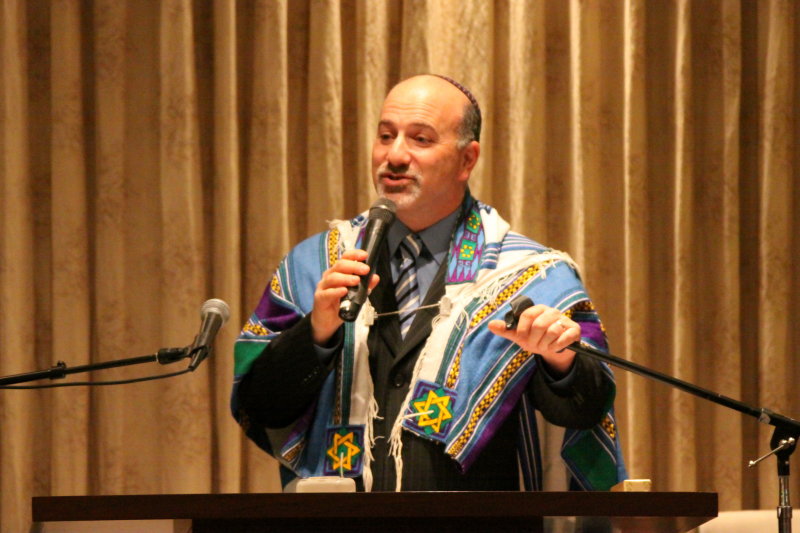
Torah teaches, “Do not place a stumbling block before the blind.” The RiPiK, a twentieth century commentator, suggested that beyond refraining from placing blocks, we should actively remove stumbling blocks. To what might this be compared?

A story…

Even as the Director of Chaverim, a local program for developmentally disabled adults asked the question, his discomfort was evident: “How do you feel about opening your congregation to a local group for developmentally disabled adults?”

“Why wouldn’t we?” I asked.

“We’ve been to other synagogues that have opened their doors, only to feel slowly push us out, after their members became uncomfortable with the presence of our members,” he responded.

The conversation continued. “What’s the worst that might happen?” I asked.

“We have one member who can sing loudly, and sometimes off-key.” He paused, “And you might have someone read slowly, completing a communal reading after others have already finished.”

“Sounds like some of our current members.”

“However, they will usually be accompanied by the Chaverim program director or program rabbi, either of whom will help direct our members if necessary. Would you like to come by one of our events to check out the Chaverim members?”

“Why? Give me a heads up when you think there might be an issue. Make sure that in the early months you attend services only when I am leading them. That way I can witness and deal with any issues that might arise.”

So We Welcomed Chaverim
“Yes, we would love to welcome you,” I said. “Let me speak to our Board in two weeks, when I know they will openly embrace the idea and your members. We will extend to any of your members full membership at our synagogue. Two High Holy Day tickets per Chaverim member – one for the member, one for his/her driver or guest. We will make you, as Director of Chaverim, a complimentary synagogue member, so that we can give you access to our synagogue afterhours for use during your scheduled programs and classes. We ask only that your members fill out a synagogue membership form so we can get them into our system.”

“They should pay membership dues,” he said. “So that they have a sense of commitment. How much should they need to pay?”

“We won’t care. Whatever you think is appropriate. No more than $50; no less than $10. We only ask that they pay it in one lump sum, to ease the work on our bookkeeper. To make it easier, you collect the forms and information, and pass them onto my assistant, who will oversee the processing of the forms.”
“Are you sure you don’t want to meet them first?” he inquired.

“Listen, we pride ourselves on being a congregation that is open and welcoming. And we have families with developmentally disabled children and relatives. So no, I don’t need to approve them. They are Jews. Let them come home.”

Not a Mitzvah (good deed), but a Mitzvah (religious obligation)
It saddens me when I hear kvelling about how this synagogue or that is especially accessible to people with disabilities. This is no mitzvah (colloquially, a good deed); it is a mitzvah (literally, a religious obligation). It is the responsibility of every Jewish community to make Jewish life and celebration accessible to every Jew and Jewish family. We strive to remove stumbling blocks from before all Jews – including those with disabilities.

As expected, the Board discussion lasted less than five minutes. The motion to welcome Chaverim was a “no-brainer.” Our CFO and his wife volunteered to be the liaisons with the program; our Program Director was tasked with smoothing the process from the staff side. We created a new membership category called ‘Chaverim,’ though we were aware that it would be a few months before anyone would officially sign up.

The next week, we designated a few Friday nights as Shabbatot when they would officially come worship with us. As I had been informed, only a few Chaverim regulars showed up at the first services to check us out and to make sure we were welcoming. Based on guidance from the Chaverim Director, early in the service when we welcome others, I just said, “We welcome our members who are connected to Chaverim, a program for developmentally disabled adults, ages 18-88.” We did not ask them to identify themselves at that time; we let them just be Jews at services.

A Service Honoring Exceptional People
We are now close to a year into our relationship. I am told that Chaverim members have attended services regularly and appreciate NOT being singled out. They hang out at the oneg like everyone else; last week I enjoyed watching our president chatting up a few Chaverim members, just like she does ever other non-regular who shows up at services. A few read prayers in our annual Service Honoring Exceptional People (our annual “Special Needs” service); others sang along and just felt like they belonged.

All because of one 20-minute phone call, one email from the Rabbi, five minutes in a board meeting, and a few calls by the Program Director. All in the span of a month.

That, and because we took seriously the Torah teaching, “Do not put a stumbling block before the blind.” It should be that easy. Please tell us your story.

Divre Harav/Words from the Rabbi – February, 2011

I am reprinting this month a bulletin article written by my colleague Rabbi Richard Hammerman.  I have added a few comments at the end.

“SAVE MONEY?  JOIN A CHURCH?”

Did you ever think, even for a moment, that, “If I wasn’t Jewish, and didn’t have to belong to a synagogue, I would save so much money?” At Church you can just get away with throwing a few bills into the basket- and take care of your conscience and your weekly religious obligations. Right?  It turns out that assumption is wrong.

According to a survey by Josh Nathan-Kazis published in “The Forward” this past September, “Jewish and Christian religious institutions appear to raise about the same amount per member, despite the fact that church giving is voluntary and synagogues charge membership dues.”

Kazis continues, “The amount raised per individual member is very similar between synagogues and churches. But the level of participation is quite different: While synagogues require roughly the same amount of dues from each of their members, church giving does not appear to be so evenly distributed.

“Take Ahavath Achim, a Conservative Jewish synagogue in Atlanta, and Church of the Heavenly Rest, an Episcopal church in Manhattan. The two congregations are broadly comparable: Both serve slightly more than 1,000 middle- and upper-middle class households, have a multimillion-dollar endowment, employ about a dozen people and operate on an annual budget of $2.7 million.

“Both draw around half their income from regular fees paid by members. But, like virtually all American churches, Heavenly Rest does not charge dues. Like most synagogues, Ahavath Achim does.  At Ahavath Achim, those fees are assigned by the synagogue, with each family paying up to $2,100 per year. Annual pledges at Heavenly Rest? As much, or as little, as you can give. While only one-third of member families participate in the church’s annual pledge drive, those that do give an average of $2,700 — far more than the cost of dues at Ahavath Achim.”

***

We collect slightly less than 1/2 of our annual budget from dues.  The rest primarily comes from the sale of Scrip, the Cadillac raffle, income from renting our building, and income from endowments.  We do not want dues to be a barrier to membership.  Please help us rely less on annual dues by making it a point to buy scrip; sell one more Cadillac ticket than last year; and consider leaving a legacy gift to the Ahavas Israel endowment.  A gift of any size will help the ensure the future of our congregation.  Ultimately, a $3 million endowment might reduce dependence on dues by 50% or ensure that the building fund will always have enough money to keep or building beautiful and in good repair.

Sustaining Relationships

A bit of Torah, which I learned from Cantor Lorel Zar-Kessler this past week and shared in my d’var Torah this morning.  It is based on the following passage:

“When a man sells his daughter as a slave, she shall not be freed as male slaves are. If she proves to be displeasing to her master, who designated her for himself, he must let her be redeemed; he shall not have the right to sell her to outsiders, since he broke faith with her. And if he designated her for his son, he shall deal with her as is the practice with free maidens. If he marries another, he must not withhold from this one her food, her clothing, or her conjugal rights. If he fails her in these three ways, she shall go free, without payment.”(Exodus 21.7–11 JPS)

שְׁאֵרָהּ כְּסוּתָהּ וְעֹנָתָהּ

Three things are obligated to to the woman sold into servitude:  Food, clothing, and ona, which might mean ointment, but which has been understood by most commentaries as (sexual) pleasure.

We can read each of these three things as metaphorical instructions for what we need to do within our marital or other relationships to sustain them.  Consider the three questions below.  I’ve suggested answers for each of them, but you might find your own ways to express the concepts of food, clothing, and pleasure in your relationships.

In our relationships, what do we give/receive that is nourishing?  We give:

  • Simple attention.
  • Loyalty. The assurance that the other is a priority in our life.
  • Support and encouraging the other’s growth as a human being with unique talents.

… how do we give protection, how do we need to be protected? We provide the clothing of physical and emotional support:

  • We can be a provider in a financial sense.
  • We give support when our partner fails, we give a hug, an encouraging word.
  • We can also honor accomplishments, affirm a sense of self-worth.

… what makes the relationship pleasurable and fun?

  • How do we laugh together?
  • How do we create moments in which we enjoy each others company?

Moses and The King’s Speech

The story of Moses is of a second born son who grew up with royal privilege but never expected to be the King. When he is called to be a leader, he tries to get out of it because he has some kind of speech impediment. He asks God to choose someone, anyone, else but him.

There are striking parallels between the story of Moses and the story of Prince Albert, who rose to the throne of the British empire as King George VI.

The second born Prince Albert never expected to be King. He never wanted to be King, because of his speech difficulty. When his brother David, who became King Edward after the death of their father, insisted on continuing a relationship with the twice divorced American Walis Simpson, it became clear that King Edward was going to have to abdicate the throne and Prince Albert was going to have to step up. He ascended to the throne at an extremely difficult time — the beginning of WWII and the beginning of the end of the British empire. He remained in London during the Blitz, ate rationed food along with the rest of his people, visited bomb sites, munition factories, and the troops abroad. He became a symbol of national resistance.

The movie “The King’s Speech,” tells this story of a reluctant Prince, struggling with his royal role and ultimately the responsibility to become King after his brother abdicated the throne – a responsibility that he feels is a Divine mandate – and his dread of public speaking because of his stammer.

Although the movie is based on historical events, it takes some liberties with history and the precise timing of the resignation of Chamberlin and Churchill’s ascent. However, the main point of the movie is not to teach us history, but to explore the relationship between Prince Albert/King George, played by Colin Firth, and his speech therapist Lionel Logue, played by Geoffrey Rush.

My colleague Rabbi Philip Pohl wrote:

As I watched the film I more clearly understood the power that must have been evident to the Israelites in the example of Moses, biblically documented as being deficient in speech, persevering through many bouts of self-doubt and lack of success. Watching the actors in the film portraying the disappointed King’s advisors and worried public made me think of the Israelites who had to wonder how it might ever be possible for the speech impaired Moses to face up to the glory and power of Pharaoh.

And then finally when success is achieved, the inspiration provided just by courage and personal persistence is palpable. The film manages to demonstrate how it is possible for a person’s ability to eventually defeat his own individual demons can serve as a model for an entire nation to be victorious over demons who threaten to destroy the world.

Imagine what the Israelites were thinking, sending Moses off to meet with Pharaoh, especially after he comes back and gives them the bad news, that they are now going to have to gather their own straw to make bricks. What did they think of Moses at that moment? What did Moses think of himself – a failed leader? One whose inability to speak well has cost his people dearly?

My colleague Charles Savenor wrote:

We might assume that God wants an eloquent speaker and someone who feels ready and eager to assume a leadership role. But instead, Moses – hesitant, scared and almost the epitome of a broken vessel – is chosen. In addition to his humility and wisdom, God chooses Moses because of his imperfections. The irony of the story is that God accepts Moses as he is. It is Moses who needs to learn to accept himself. Ultimately, Moses was able to be a leader in spite of his limitations.

It is precisely when the task seems so large that we need to remember that Moses’ inadequacies and hesitations did not hold him back from being a leader. In fact, when exposed firsthand to injustice and cruelty, he takes immediate action without stopping to consider the personal ramifications.

…. We are all like Moses in that each of us has our own challenges and shortcomings. Similarly, each of us has a unique contribution to make – to our communities, to society, to the world – if only we learn to accept ourselves as we are.

Dale Carnegie, in his books and in the course that bears his name, teaches that the quality that makes a speaker compelling is not having mastered the mechanics of speaking with a powerfully resonant voice or the words one uses, but rather the passion and enthusiasm and commitment to the message one is trying to deliver. We find the fullest expression of ourselves when we both accept our limitations and work to transcend them.

The Reuben

I’ve been trying to write something about the movie “The King’s Speech” (which was the subject of my d’var Torah this past Shabbat), a must-see movie, but haven’t quite gotten it right yet.  In the meantime, see the movie and think about Moses.

For now, take a look at this video on Youtube:  http://www.youtube.com/watch?v=77z2VsqEmXk

What are we talking about here?  A sandwich, yes, but much more.  What is the role of “tradition” in Judaism?  Just because something is an ancient custom, should we take it more seriously than if it were a newly invented ritual?  Does a ritual that has its origins in New York – or Mount Sinai – have more authority than one which comes from a different place or time?  What makes a ritual Jewish?  How much can we remove from a traditional Jewish practice before it no longer is Jewish?

The video raises these delightful questions, and at the very end should make you laugh … and if you enjoy eating Reuben sandwiches, should make you think twice!