
Divre Harav – March, 2025

As I write this article, my heart is heavy, awaiting the release of the rest of the hostages from phase one of the Gaza cease fire agreement. There are 15 more presumably living hostages and the bodies of eight hostages who are no longer alive yet to be returned. There is no indication of how many of the remaining 65, whose return will, God willing, be part of a phase two agreement, are still alive.
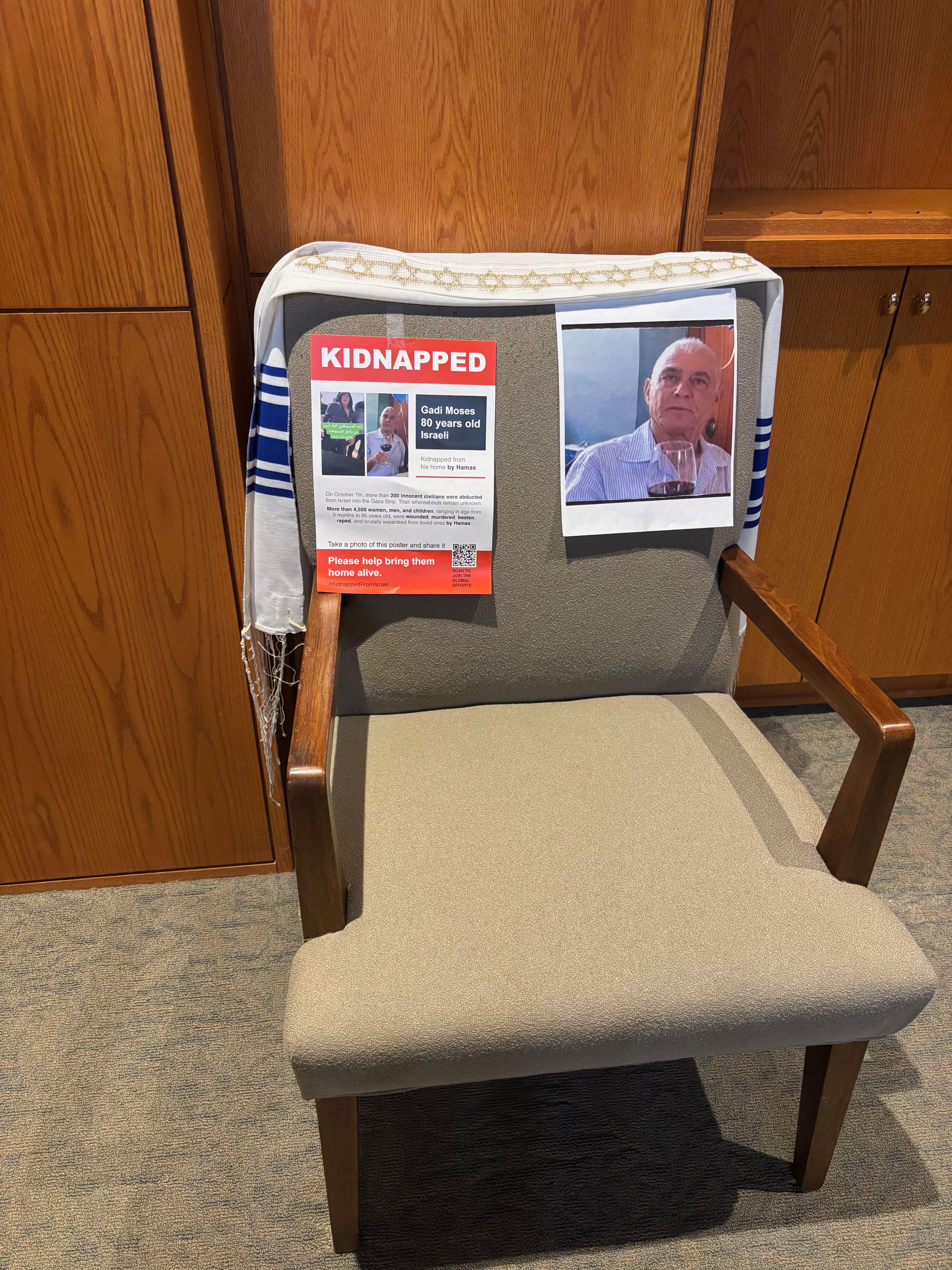
At the same time, I rejoice with relief at the images and video of the hostages who have been returned and reunited with their families. In particular, I am grateful that Gadi Moses, the hostage whose picture has occupied a chair on the Bima during our services and a chair in the meeting room during Kiddush and meetings, has been released.

According to interviews following his release, while held hostage by Hamas for more than 15 months in Gaza, 80-year-old Gadi Moses ate mainly a piece of bread and an olive twice a day. He lost 15 kilograms, about 33 pounds during his captivity. During that time, he was given a small bowl of water to wash himself every five days and had to ask to use the toilet. He moved frequently and was mostly alone, typically held in a room about 2 meters square (slightly more than 6 feet square). He calculated math problems in his head to distract himself, and walked up to 11 km (six miles) a day, measuring the distance by walking the perimeter of his room.

Gadi Moses helped build Kibbutz Nir Oz with his bare hands. A passionate agronomist and farmer, he used the knowledge he found studying the ground and how to make things grow to help foreign countries grow crops. Gadi adored explaining the fine details of agriculture to people coming to the Israeli kibbutz for instruction. In his retirement, he built a communal garden there. A lover of fine wines, he grew grapes as a hobby. He loved nothing more than nature and his family, his three children and his grandchildren.

I have reached out to Gadi to offer my gratitude that he is back home and to invite him, if and when he is able to travel, to visit us in Grand Rapids, sit in the chair we had designated for him, and speak to us about his experience and his plans to rebuild his beloved Kibbutz community.

As we celebrate Purim this month and Pesah next month, let us remember that the evil represented by Haman and Pharaoh are not just stories; they are a real part of the world in which we live and a real threat to our continuing ability to publicly live out of Judaism in the world today. Gathering to hear the Megillah and to celebrate a Seder is our way of saying, “No matter how hard you try to prevent us from embracing our Torah and living our Jewish lives, we will persevere!”

Hebrew word(s) of the Month:

  • ne’edar – missing
  • nishbah – taken captive
  • ḥatufim – hostages
  • m’shuḥrar – freed

Divre Harav – February, 2025

The changing religious shape of Jerusalem and Israel

I had dinner with some friends in Israel who made aliyah last year. They are a typical religious family living in South Jerusalem in the neighborhood of Arnona-Talpiyot, not too far from the future site of the American Embassy. Their children, two of whom I met at dinner, had preceded them in moving to Israel. I spoke to the two daughters about their post high school service to the country. As a matter of law, young women are obligated to do military service. However, religious women are automatically exempted from any service. One daughter accepted the exemption from the army and did alternative national service. She explained there wasn’t even a question in her mind of whether to volunteer for national service. Israelis serve their country after high school and that’s why she didn’t take full advantage of the exemption. The other daughter, who served in the army, explained that she didn’t qualify for the exemption because she wasn’t religious. I was impressed by her honesty. She lives with her parents in a religious household, so she basically conforms to religious norms. She could have signed a statement to this effect and accepted a full exemption. But she felt the strong pull of a young Israeli to do regular army service.

From what I observed and from what other friends told me, this is typical of the fluid religious atmosphere of South Jerusalem and other parts of Israel where religious and secular live side by side. The lines between religious and non-religious are not as clear as they once were. Religious families need not be ultra-nationalists living deep in Judea and Samaria in order to feel a sense of patriotic duty to the state. The non-Orthodox gather in small groups for Shabbat and to celebrate holidays. The Conservative/Masorti movement is growing slowly, but the number of informal, grass-roots, egalitarian, minyanim is exploding. People want community and if the official state rabbinate is not going to provide a type that fits their needs, a Jewishly well-educated, Hebrew-literate, public need only gather ten or more like-minded people in a public or inexpensively rented space and create it themselves. Best of all, it is fueled largely by native Israelis as much as North American immigrants.

A generation ago, common wisdom suggested that every Israel was Orthodox, even if they were completely non-observant. Today, they may not be familiar with the non-Orthodox movements, but they understand what it means to be shiv’yoni, egalitarian. The founding generation of Israel was militantly secular, and society clearly divided Ashkanazi and Mizrahi from one another. Today’s generation has thoroughly mixed Jews of European, Asian, and North African descent (central African Jews are still working towards full inclusion), and the secular population has an appreciation of Judaism from a secular school system infused with Jewish texts and traditions. There are still neighborhood and isolated areas populated by a kind of 18th and 19th century Judaism, but for the most part, socially and religiously, Israel has leapt gracefully from the 19th to the 21st century.

In a visit overshadowed by the dark cloud of war and the gloom of hostages held in Gaza, the energy of Jerusalem’s religious life was a beam of sunshine.

Hebrew word(s) of the Month:

  • Tz’va Haganah L’Yisrael (typically abreviated as Tzahal) – Israel Defense Force
  • Sherut Le’umi – national service
  • Masorti – “traditional.” The name of the Conservative movement of Judaism in Israel and worldwide.
  • Shiv’yoni – “egalitarian”

Divre Harav – December, 2024

The Rabbinical Assembly, the international professional organization of Masorti/Conservative rabbis, is holding its annual convention in Jerusalem this month, and I will be there. Rather than looking for the least expensive plane ticket, I choose to buy a ticket on El Al, Israel’s national airline. First of all, in these troubled times, I want to support the economy of Israel any way I can. Secondly, in the past year other airlines have frequently, with very little notice, canceled flights to Israel or stopped service altogether. El Al has reliably continue to fly.

For the past nearly 14 months Israel has been subject to tremendous trauma – a war on two fronts, missile and rocket attacks, terror attacks on the streets of major cities, and the ongoing suffering of more than 100 hostages held in Gaza. Yes, I know that the residents of Gaza are living amidst devastating destruction and death. For that I blame their elected government, Hamas.

The RA has kept its commitment to hold its convention in Israel because the least it can do is support our Israeli colleagues by joining with them for a few days of learning side by side with them. I am going to Israel because the least I can do is to experience first-hand what it’s like to live under the threat of attack, learn how Israel is addressing trauma and planning for a better future, and spend some of my resources to lift up the tourism economy. If you want to join me as a “virtual tourist” and help me spend some money and give some tzedakah in Israel, I invite you to make donations to my discretionary fund. When I return, I’ll report back on what I’ve seen and done, and how your donations have improved the lives of our Israeli siblings. I leave December 4, and I’ll return December 16.

If you haven’t heard or read my Rosh Hashanah sermons, download them from AhavasIsraelGR.org to consider some ways that you can build closer ties to Israel as its indigenous people. And please contact me if you would like to host a gather for you and a few of your friends to talk about planning a community trip to Israel next year or early in 2026.

Hebrew word(s) of the Month:

  • • Molad’ti – My homeland
  • • Yelidi – Indigenous
  • • Ha’aretz – The Land, always a reference to the land of Israel

Divre Harav – May

May 14 will be 220 days since the unprovoked attack and horrific massacre of Israeli civilians, men, women, and children, in the area around Gaza. As I am preparing this article in early April, there are still 134 hostages being held by Hamas, approximately 100 of whom may still be alive.

On May 14, we will celebrate Israel Independence Day, the 76th birthday of the modern State of Israel. Israel was established on our ancestral land to be a place where Jews could find refuge and rebuild a state infused with our fundamental Jewish values. By any measure, Israel has been a phenomenal success. It has welcomed immigration of individual Jews and Jewish families and entire Jewish communities from around the world and it has prospered. It has reach out in times of crisis to countries around the world with assistance. It has signed agreements of peace and economic cooperation with a growing number of its neighbor countries in the Middle East.

The upcoming celebration of Yom Ha’atzma’ut ought to be an unqualified celebration, yet we cannot celebrate with our full hearts while hostages are still held in Gaza and while Israeli soldiers are still putting their lives on the line to recover our missing and hold those responsible for October 7 accountable for their actions.

Of these two things I am certain:

  • If the people of Gaza, who elected Hamas to be their representative government, would rise up and return the hostages to Israel along with the leadership of Hamas responsible for October 7, the war would end the next day.
  • If the people of Israel would lay down their arms tomorrow, the hostages would remain in captivity and Hamas would, as they promised, prepare to renew attacks against Israel.

You might wonder whether we should celebrate Yom Ha’atma’ut this year. I do not. I can still see Treblinka, Majdenek, and Auschwitz when I close my eyes, from my trip to Poland last year. Had there been no Israel in 1948, who would have taken in the almost 300,000 European Jews who sought refuge there? The United States took in 150,000 in the 10 years following the Shoah. Israel took in twice that many in just five years. Had there been no establishment of Israel, who would protect Jewish communities of Iraq, Iran, Syria, Yemen, Egypt, Morocco, and Ethiopia, and elsewhere in the Middle East and Africa, in this era of rising antisemitism? Many of these communities chose to make Aliyah in the years following the establishment of Israel. If Israel were to cease to exist as a Jewish State tomorrow, what would happen to its 7.2 million Jews (out of a total population of 9.8 million)? Where would they go – because one thing is for certain, they are not welcome in the Hamas or Palestinian Authority controlled areas of Gaza or the Judea and Samaria (the “West Bank”).

It was a Friday afternoon on May 14,1948 when a small Jewish community, led by David Ben Gurion, read the declaration of Independence and proclaimed the State of Israel. I hope you will join me and Ahavas Israel in our celebration of Yom Ha’atma’ut on Tuesday evening, May 14. You can find details elsewhere in the Voice.

Hebrew Phrases of the Month:

  • Megillat Ha’atzma’ut – “The Declaration of Independence”
  • Tzur Yisrael – “Rock of Israel” – a phrase in the Megillat Ha’atzma’ut that some read as a reference to God, and others, to the Israeli army.
  • Medinah Yehudit – “Jewish State” – The Megillat Ha’atzma’ut proclaims the establishment of a Jewish State in …
  • Eretz Yisrael – “The Land of Israel” – The Biblical, ancestral, land of the Jewish people, to be known as …
  • Medinat Yisrael – “The State of Israel”

Divre Harav – December, 2023

We, who love Judaism, probably do so because we love the holidays, the life cycle events, maybe the structure and content of prayer. We may also love the system of ethics as it applies to personal spiritual growth or medicine or even business. And of course we love Torah and we ought to love Israel as well, the land that it clearly given to us as a place to exercise sovereignty and self-determination. And that it why so many of us have been in emotional and spiritual agony since October 7, the day on which the terrorists of Hamas butchered our young and our old and kidnapped about 240 of our brothers and sisters to use as human shields.

I’m writing this article on November 1, to be published on December 1, hoping, but not at all confident, that Israel’s war against Hamas in Gaza will have ended. There are some aspects of Jewish law and ethics that are unpleasant and messy and among them are the laws of war. We think of Jewish ethics as a system designed to elevate the human being to reflect the face of God and to connect people to each other in loving ways. But sometimes ethics teaches us how we might defend ourselves by shooting guns and missiles, dropping bombs, laying siege to a city, cutting off electricity, food, and water, in order to achieve an ethically defensible goal – that of preserving our lives at the expense of those who are trying to kill us and those who are supporting them.

I don’t have the military expertise to wage war. I rely on colleagues with both rabbinic ordination and military training to teach me, just like I rely on attorneys to guide me on legal issues and mechanics to fix my car and my heat and air conditioning. I try not to take strong positions on issues outside my field of expertise. And despite writing a column entitled, “Ethics and Religion Talk,” when it comes to the ethics of war, I am not an expert.

I know that some portion of the population of Gaza are people who fundamentally disagree with Hamas and are afraid to say that publicly, lest they put their lives as risk. I know that some portion of these people are children, complete innocents.  I do not know of a way to wage war without putting innocent, non-combatant, lives at risk. I am confident, however, that the Israel military goes above and beyond the letter of the Law of Armed Conflict as it warns civilian populations before bombing a target in their area, trying to minimize collateral casualties. And I will remind you, unnecessarily, I hope, that the enemy that Israel is fighting goes out of its way to maximize non-combatant casualties, and has said, repeatedly, that its fight is not over until Israel no longer exists.

So you may not love the parts of Judaism that try to offer guidance to the messy, ugly, business of waging war. But for a thousand years, Jews were sovereign in the land of Israel under King Saul, King David, and his dynasty. And they protected the land and the people with their blood. And Jews were generals and leaders under the Moslem government of early medieval Spain. Jewish communities protected themselves from Pogroms in Russia. Jews fought for this country against the scourge of Hitler and his Nazi thugs. And I wish that all people of the world would melt down their weapons and turn them into farming implements, but until that happens, I thank God and pray for the Israel Defense Forces.

Hebrew Phrase of the Month:

  • • Am Yisrael ḥai! – The nation of Israel lives!