Divre Harav – January, 2025

Question: How many day of Hanukkah will there be in 2025? 
Answer: Ten!

This is a companion riddle to the question, How many days of Hanukkah were there in 2024?
Answer: Six!

Of course, neither the length of Hanukkah nor the size of the Hanukkah menorah change from year to year. The years that Hanukkah crosses the secular new year are just a reminder that we live our lives as Jews with one foot in the civil calendar and one foot in the Jewish lunar-solar calendar. But Jews had been living dual lives for over 500 years before the creation of the calendar based on the Christian counting of years. During the Babylonian exile, some Biblical months known simply by number adopted the contemporary Assyrian/Babylonian names (the fourth month became Tammuz, the fifth month became Av). Other Biblical month names were dropped in favor of the contemporary names (Nisan replaced the Biblical Aviv, Iyar replaced the Biblical Ziv, Tishre replaced the Biblical Eitanim, Marheshvan replaced the Biblical Bul).

The privilege of setting the calendar belongs to the dominant culture. They determine days of rest and holidays. The minority cultures within tend to adopt their calendar because it is necessary to share a common frame reference to time with our neighbors. But we also retain our own calendar to remind ourselves that we march to the beat of a different drummer.

We celebrate Tuesday, December 31 and Wednesday, January 1 as ‘Rosh Hodesh,’ the beginning of the month of Tevet, with songs of Hallel in our morning prayers. Why two days? Because a lunar month is 29.5 days. When a Jewish month is 30 days long, the new moon actually begins near the end of the last day of the previous month, so both that day and the first day of the next month are celebrated.

This month, our calendar directs us to commemorate the beginning of the Babylonian siege against Jerusalem in 589 BCE on the 10th of Tevet (Friday, January 10). The month of Tevet in Akkadian/Babylonian means ‘muddy.’ Tevet falls in the middle of the rainy season. This makes sense – in Israel, Tevet is the rainiest month.

Next month, we remember the 15th of Shevat as the day that trees become one year older (Thursday, February 13). The name of the month comes from an Akkadian word meaning “strike,” also referring to heavy rains striking the land during the winter season.

Each year, we remember the death of loved ones on the anniversary of their death on the Hebrew calendar. To do so is to recall their death and observe Jewish rituals of memory in the context of our calendar, our counting of the months and days.  I encourage you to observe the Yahrtzeit by saying Kaddish on the Shabbat prior to their Yahrtzeit. And if you are able to help gather a minyan on the day of the Yahrtzeit itself, our custom is to say Kaddish on that day as well.

Yes, we are westernized Americans and we live according to the civil calendar. But in order not to forget our indigenous Jewish roots in the Tanakh and in the land of Israel, we should also live our lives according to the rhythms of the Jewish calendar.

Hebrew word(s) of the Month:

  • Kislev, Tevet, Sh’vat – the winter months
  • Adar, Nisan, Iyar – the spring months
  • Sivan, Tammuz, Av – the summer months
  • Elul, Tishre, Marheshvan – the fall months

Divre Harav – December, 2024

The Rabbinical Assembly, the international professional organization of Masorti/Conservative rabbis, is holding its annual convention in Jerusalem this month, and I will be there. Rather than looking for the least expensive plane ticket, I choose to buy a ticket on El Al, Israel’s national airline. First of all, in these troubled times, I want to support the economy of Israel any way I can. Secondly, in the past year other airlines have frequently, with very little notice, canceled flights to Israel or stopped service altogether. El Al has reliably continue to fly.

For the past nearly 14 months Israel has been subject to tremendous trauma – a war on two fronts, missile and rocket attacks, terror attacks on the streets of major cities, and the ongoing suffering of more than 100 hostages held in Gaza. Yes, I know that the residents of Gaza are living amidst devastating destruction and death. For that I blame their elected government, Hamas.

The RA has kept its commitment to hold its convention in Israel because the least it can do is support our Israeli colleagues by joining with them for a few days of learning side by side with them. I am going to Israel because the least I can do is to experience first-hand what it’s like to live under the threat of attack, learn how Israel is addressing trauma and planning for a better future, and spend some of my resources to lift up the tourism economy. If you want to join me as a “virtual tourist” and help me spend some money and give some tzedakah in Israel, I invite you to make donations to my discretionary fund. When I return, I’ll report back on what I’ve seen and done, and how your donations have improved the lives of our Israeli siblings. I leave December 4, and I’ll return December 16.

If you haven’t heard or read my Rosh Hashanah sermons, download them from AhavasIsraelGR.org to consider some ways that you can build closer ties to Israel as its indigenous people. And please contact me if you would like to host a gather for you and a few of your friends to talk about planning a community trip to Israel next year or early in 2026.

Hebrew word(s) of the Month:

  • • Molad’ti – My homeland
  • • Yelidi – Indigenous
  • • Ha’aretz – The Land, always a reference to the land of Israel

Divre Harav – November, 2024

Cultivating gratitude begins with the reflex ‘thank-you’ that parents teach children. We teach children to say thank you when someone gives them a gift or does something nice for them. We tell them to say thank you. We might even force them to say thank you by threatening to take back the gift. We know that very young children say thank you only because they have to and not because they feel a sense of gratitude. Nonetheless, it is an important first step in building a practice of gratitude. The Jewish source for this comes from the Talmud [Sanhedrin 105b], regarding Torah study or doing mitzvot, mitokh shelo lishma, ba lishma, “from doing something not for its own sake, one will come to do it for its own sake.”

Ultimately, though, we want to cultivate a real, deep sense of gratitude. We’d like for the practice of saying thank you to be an expression of the gratefulness we feel in our souls, not just a barely remembered reflex. This begins with an attitude of how we do things for others. Take a lesson from Pirke Avot [1:3]:

“Do not be like servants who serve the master in the expectation of receiving a reward. Rather, be like servants who serve the master without the expectation of receiving a reward.”

When we volunteer, help others, serve others, or do acts of kindness simply because we want to help, or because it is the right thing to do, or even out of a sense of obligation or commandedness, we cultivate a habit of not expecting the reward of a ‘thank you.’ Any gratitude we get back is an unexpected bonus, a delight to be appreciated and savored. This leads us towards a deeper sense of appreciation for the kindnesses others do for us with no expectation of reward. Because we know how it feels to get an unexpected thank you, we are more likely to feel a deep sense of gratitude, and the thank you that we offer will flow from depths of our soul.

In short, the path to becoming a more grateful person begins with doing quiet acts of kindness for others. Anonymous gifts of tzedakah, bringing a meal to someone experiencing some kind of difficult situation, volunteering to help with a synagogue program or support a minyan, or sit with a friend in a time of need.

Some people, at their Thanksgiving table, have a practice of going around the table and sharing something that they are thankful for. Maybe this year, try instead to share a moment when you received an unexpected gift of gratitude, and a moment when you gave someone the gift of an unexpected thank you.

Hebrew word(s) of the Month:

  • Modeh Ani L’fanekha – A piece of the morning liturgy, “I am grateful to you …”
  • Todah – thank you

Divre Harav – October, 2024

So many emotions.

If we don’t celebrate our holidays or if we allow our enemies to define how we celebrate, we are giving them a victory. Do we want to allow them to live inside our heads and sit at our Rosh Hashanah table with us, prevent us from eating apples and honey and praying for a sweet new year? I don’t want the perpetrators of evil to define my atonement on Yom Kippur, and I won’t let them disrupt my celebration of Sukkot. If I diminish my Simhat Torah, then I am reducing the very heart of the Jewish experience.

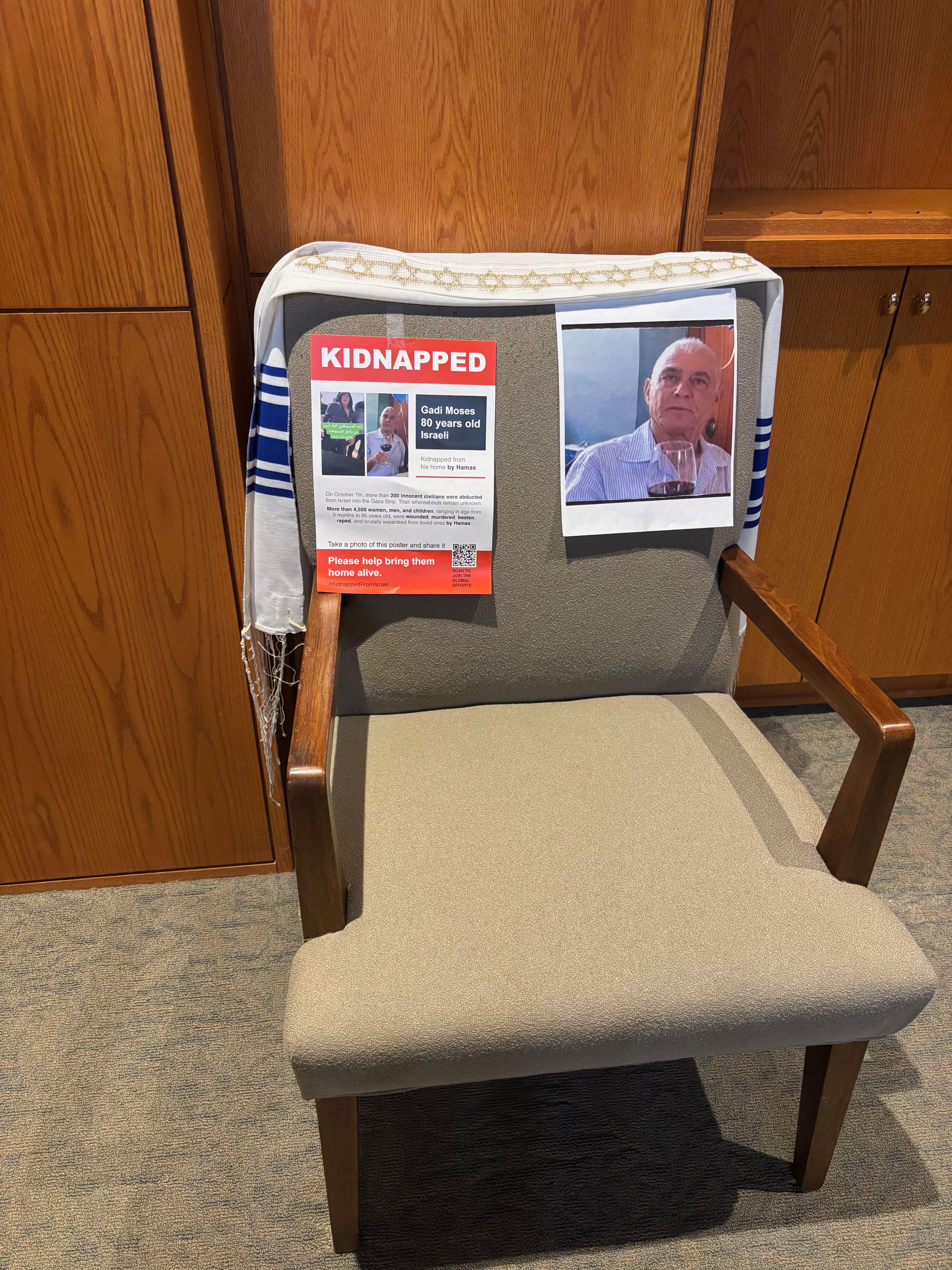
Yet, how can I celebrate with a full heart a full year after my brothers and sisters in Israel have been attacked, taken captive, and held in inhumane conditions, in tunnels and in fear, in deprivation and in pain?

The answer is to set aside time during our season of festival days to remember. Following Rosh Hashanah and preceding Yom Kippur, the Grand Rapids Jewish community is joining together for an October 7th commemoration on Sunday, October 6, at 6:30 p.m. at Temple Emanuel, 1715 East Fulton. Join us for prayers in memory of those whose lives have been lost, on that horrific days and in the days and months following, and those taken hostage yet to be returned. We pray for the Israel Defense Forces and for the strength of the State of Israel to be a beacon of Jewish values to the world. We’ll also hear from both leaders in the Jewish community and civic leaders from Grand Rapids.

We need to tell the world, in one unified voice along with Jewish communities around the world, that we stand with Israel, with human dignity, with freedom of religion. Our message needs to be that we come from Zion, that our 3400 year old connection with the land of Israel is not as a 20th century colonial power, but as a people returning to their ancestral homeland.

I hope to see you on Rosh Hashanah to celebrate the new year and begin the process of repentance. I hope to see you on Yom Kippur to renew our connection to God and ask for full atonement. I hope to see you on Sukkot to celebrate the bounteous fall harvest. I hope to see you on Simhat Torah to celebrate and dance with the beating heart of Jewish life, Torah. And, please, join me for this important commemoration as well.

Shana Tova, may this be a good year for the Jewish people.

Hebrew word(s) of the Month:

  • Am Yisrael Chai! The Nation and People of Israel Lives!

Divre Harav – September, 2024

We’re about one month away from the fall holidays. During the month of Elul, beginning on Wednesday, September 4, one month before Rosh Hashanah, our tradition encourages us to engage in introspection.What kind of person do I want to be? Where is there room for growth and improvement? Where have I been holding on to grudges or unresolved issues? How can I correct the course of my life and become kinder, more loving, more forgiving? How can I better reflect the Divine spark within me?

Some people make it a point to journal during Elul. Each evening, before going to bed, spend 5-10 minutes writing about something you did well that day and some place you fell short and hope to improve on. You might consider writing or revising your ethical will, a letter (doesn’t have to be long) articulating some lessons you’ve learned in the course of your life, and moral guidance and hope for future generations. My colleague Rabbi Steven Abraham of Beth El Synagogue in Omaha, Nebraska, offers the following questions to get you started:

  • What are each of our core beliefs and values?
  • How have these beliefs and values manifested themselves in our lives? Are there further ways we’d like them to?
  • What teachings from our parents, grandparents or siblings that speak to us do we want to pass on?
  • What two or three life lessons need to be written down?
  • What are we grateful for in life?
  • Sometimes imagining that you only have a limited time left brings to mind the things in life that are truly important – what are those things for you?

You might also devote a few minutes a day to reading and learning more about the spiritual practices of Judaism and its holidays. Here are a few website to look at. You can sign up for weekly email to bring a bit of learning right to your inbox.

  • ExploringJudaism.org – this is a new project of the Conservative movement, with a growing number of articles reflecting traditional Jewish practice in today’s world.
  • Myjewishlearning.com/ – At more than 20 years old, My Jewish Learning is a granddaddy of Jewish learning websites.
  • Sefaria.org/community – Sefaria is primarily a library of Judaic texts, but also has a library of articles on topics of holidays, Jewish thought and values, mitzvot, and Torah study.

Elul prep for Rosh Hashanah and Yom Kippur can be seen as a kind of self-care for one’s soul. Just as you bring your car into the shop for regular oil changes and tune-ups, and you maintain your home HVAC system, changing filters regularly, your body and soul need attention as well. Marisa joins me in wishing you a joyful high holiday season.

Hebrew word of the Month:

  • Heshbon Nefesh – An accounting of the soul
  • Tzava’ah – An ethical will