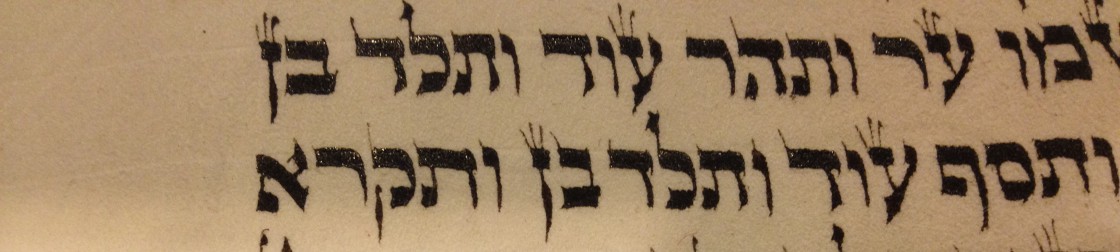
All my bones shall say, “Adonai, who is like You?” (35:10)
This verse from Psalms reminds us that our whole body can be engaged in prayer. Prayer need not be merely an intellectual exercise or even just an emotional experience. Prayer can also be a physical experience. We can pray while we move our bodies – “shuckeling” is the Yiddish term for the quintessentially Jewish back and forth swaying motion of traditional prayer. We can pray while we walk. A walking meditation typically invites us to focus on our breath and balance and body movements. A long distance runner might experience a “runner’s high,” that point when the exhausted body releases endorphins. It might feel like God breathed out a healing breathe.
On another level, prayer should never only be petitionary. If prayer is only about asking, then God is reduced to a vending machine. Prayer should also be about cultivating goodness. Prayer should affect my bones, my body. If prayer has not transformed my very being into a different person, then it has not truly been prayer (I should add here parenthetically that I believe most prayer, including my own, is very rarely true prayer). It is only when “all my bones/my essence” are involved in the experience that we achieve a complete connection with the Divine.
Finally, God is unique. That is the essential proclamation of the Shema.. This psalmist asserts that God is entirely Other, that no one and nothing is like God. This particular statement would seem to exclude the Hasidic/panentheistic view that God’s uniqueness is manifested by virtue of God infusing all reality – “There is no place free from God’s presence.” However, the beauty of Biblical theology through a Jewish lens is that it does not present a single monolithic view of God, so we can certainly also find support for the notion that God’s oneness means that nothing is separate from God.
 Embodied Torah