
Divre Harav – March, 2025

As I write this article, my heart is heavy, awaiting the release of the rest of the hostages from phase one of the Gaza cease fire agreement. There are 15 more presumably living hostages and the bodies of eight hostages who are no longer alive yet to be returned. There is no indication of how many of the remaining 65, whose return will, God willing, be part of a phase two agreement, are still alive.
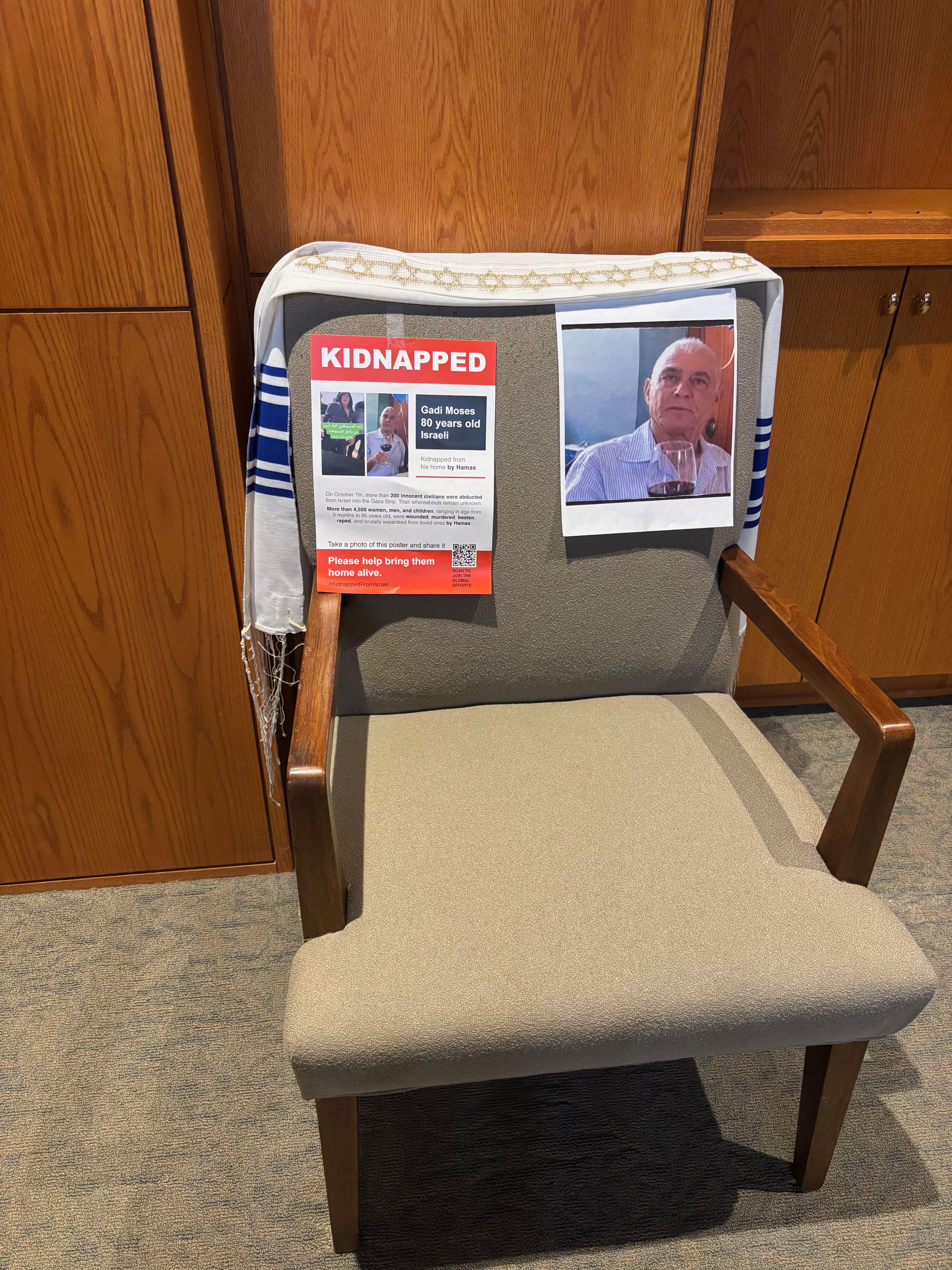
At the same time, I rejoice with relief at the images and video of the hostages who have been returned and reunited with their families. In particular, I am grateful that Gadi Moses, the hostage whose picture has occupied a chair on the Bima during our services and a chair in the meeting room during Kiddush and meetings, has been released.

According to interviews following his release, while held hostage by Hamas for more than 15 months in Gaza, 80-year-old Gadi Moses ate mainly a piece of bread and an olive twice a day. He lost 15 kilograms, about 33 pounds during his captivity. During that time, he was given a small bowl of water to wash himself every five days and had to ask to use the toilet. He moved frequently and was mostly alone, typically held in a room about 2 meters square (slightly more than 6 feet square). He calculated math problems in his head to distract himself, and walked up to 11 km (six miles) a day, measuring the distance by walking the perimeter of his room.

Gadi Moses helped build Kibbutz Nir Oz with his bare hands. A passionate agronomist and farmer, he used the knowledge he found studying the ground and how to make things grow to help foreign countries grow crops. Gadi adored explaining the fine details of agriculture to people coming to the Israeli kibbutz for instruction. In his retirement, he built a communal garden there. A lover of fine wines, he grew grapes as a hobby. He loved nothing more than nature and his family, his three children and his grandchildren.

I have reached out to Gadi to offer my gratitude that he is back home and to invite him, if and when he is able to travel, to visit us in Grand Rapids, sit in the chair we had designated for him, and speak to us about his experience and his plans to rebuild his beloved Kibbutz community.

As we celebrate Purim this month and Pesah next month, let us remember that the evil represented by Haman and Pharaoh are not just stories; they are a real part of the world in which we live and a real threat to our continuing ability to publicly live out of Judaism in the world today. Gathering to hear the Megillah and to celebrate a Seder is our way of saying, “No matter how hard you try to prevent us from embracing our Torah and living our Jewish lives, we will persevere!”

Hebrew word(s) of the Month:

  • ne’edar – missing
  • nishbah – taken captive
  • ḥatufim – hostages
  • m’shuḥrar – freed

Divre Harav – Summer, 2021

The Talmud consists of 38 volumes of disputes. As such, it has much to teach us about how to engage in discussion and, even more important, how to disagree agreeably. What happens after a group reaches a non-unanimous decision? 

In one tragic model, Rabbi Eliezer was the sole voice in a decision that was decided against him. He took the disagreement personally and kept arguing long after the vote was over. The sages took his intransigence personally and excommunicated him. Rabbi Akiva tried to soften the blow, but Rabbi Eliezer was distraught. Tears and waves of anger, as described in the Talmud, threatened to destroy the world. His wife, Imma Shalom, wouldn’t let him say certain prayers lest his fury do more damage. She left him alone for a few moments, however, and his unsupervised prayer led to the death of her brother Rabban Gamliel, the leader of the Sages who had voted for his excommunication.

Ill feelings might not literally destroy the world, but when we are unwilling or unable to let go of anger and resentment when something doesn’t go our way, a disagreement can become a rift that seriously damages a community. The losing side needs to know when it is time to stop fighting and start adjusting to the new reality. The winning side should behave with sensitivity and not gloat over its victory, understanding that the other side had good reasons for their passionate arguments. 

The better model is that of Hillel and Shammai, who fundamentally disagreed about the nature of Jewish Law. Yet even though they disagreed about fundamentals of marriage and divorce in ways that might cast doubt on the validity of the children’s status, their respective students continued to marry each other’s children. The respect that each side had for the other’s position prevented the dispute from fracturing the Jewish people into two different religions.

Our United Jewish School model includes language in our governance documents that asks us to work towards consensus decision-making. Neither congregation can take action alone – significant decisions require a majority from each side. Virtually every decision we’ve made in the past 15 years has been consensus. But this is an unusual situation. More often, our decision making bodies do occasionally reach a point where a principled disagreement requires a vote. Organizations cannot allow an inability to reach consensus to paralyze them into inaction. At those times, we turn to the Talmudic model, reaching for “disagreement for the sake of heaven” in which both sides listen deeply to what the other is saying, discuss ideas rather than attack ad hominem, argue with reason rather than fear, and strive to reach for truth rather than for victory.

Hebrew Words of the Month:

  • Mahloket – disagreement
  • Vikuah – debate
  • Ta’anah – argument
  • Riv – dispute
  • Sikhsukh – feud

Psalm 143

“Do not enter into judgment.” (143:2)

The temptation to judge other people according to our standards and expectations is high. Despite protestations to the contrary, a religious life invites making such judgements because we have the yardstick of sacred scripture as both a measuring device and a stick with which to beat transgressors. Resist the temptation, unless there is a strong potential that you or someone else will otherwise be hurt. Instead, walk a mile in their shoes and try to understand why they do what they do. Cultivate compassion, rather than judgement.

Psalm 140

“Keep me from those prone to violence.” (140:5)

I have never felt seriously threatened with physical violence. When I lived in Manhattan, there were a few times that I was walking down a deserted street at night and remember wishing that there were more people around, but that’s the extent of my awareness of the forces of chaos and human evil.There are people who are more attuned to the potential for violent behavior among strangers than I am and who prefer to carry a weapon. I look to law enforcement as my friends and have never felt a desire to own a firearm to protect myself. If that makes me naive, then it is, to borrow a phrase from Paul Ricoeur, a willed naiveté with which I am perfectly content.

Divre Harav/Words from the Rabbi – December, 2017

Hillel says, “Do not separate from the community – do not be sure of yourself until the day of your death and do not judge your fellow until you are in their place. Pirke Avot 2:5a

Protestants are famous for disagreeing and forming new denominations. Jews are just as disagreeable, but tend merely to form new synagogues rather than new movements. Apparently, this is not a new phenomenon. Hillel, a first century BCE pre-rabbinic figure, cautioned people of his generation not to fracture the community. He then gives two specific warnings against behaviors that would lead people to separate from others in their community.

First, don’t be too sure that you are right and the other person is wrong. Don’t stake your participation in the community or your relationship with that individual on your correctness. Have the humility to open yourself up to the possibility that the opposite is true, that you are wrong and the opposing opinion is correct. It will not be until you have passed away and are called before the Holy Blessed One, the Supreme Judge, that you will know the whole truth of the matter.

Second, you might think the other person is dead wrong and be tempted to withdraw from the relationship. However, because you are not omniscient, you don’t know what led your fellow to make certain decisions and to choose a particular path. Were you in his or her shoes, you might have chosen to make the same set of decisions. Therefore, do not so quick to disconnect either with that person or with a community of people who make decisions that you do not fully understand.

Hillel was a strong proponent of remaining in relationship and learning from people who are different from you. He would be deeply disappointed at the degree to which our society is broken into segments who only read or listen to news that confirms what they already believe, and associate only with people of a like mind.

Don’t separate from the community even when remaining in the community is challenging, because that’s precisely when you have the most to learn and others have the most to learn from you. Be humble and non-judgemental and remain in the community with the goal of enriching yourself. For Hillel and for us, Judaism is not a religion to be practiced alone in one’s home. The concept of minyan urges us to pray in community, not because God hears communal prayers better than solo voices, but because we are more powerfully transformed by prayer when we are not alone.

Hebrew Words of the Month:

Common “first” names of synagogues:

  • Aidah (or Adat) – Congregation, (Congregation of …)
  • Kehillah (or Kehillat) – Congregation (Congregation of …)
  • Kahal (K’hal) – Congregation (Congregation of …)
  • Agudah (Agudat) – Congregation (Congregation of …)
  • Beit (often transliterated Beth) – House of …
  • B’nai – children of …
  • Anshei – People of …
  • Mishkan – Temple