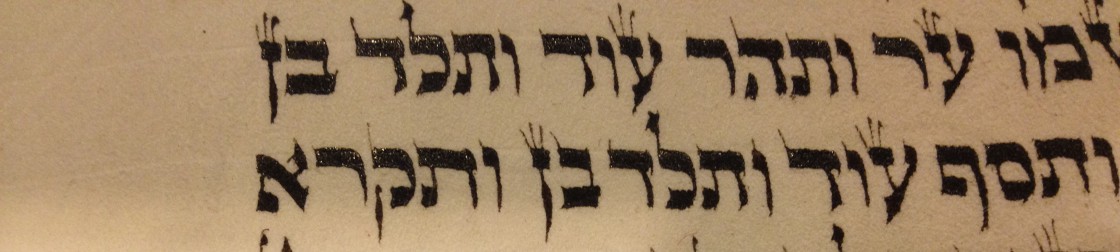
A Hasidic teaching I studied recently suggested that God is represented by words. God is found in the words of the revelation at Sinai, the words of Torah. But it also suggested that when we live our faith fully, that we not only hear God’s words, we also actually hear God’s voice, a more powerful connection.
The difference between words and a voice is this: Words might be seen as an artifact of an ancient world, the dusty remnants of a previous generation. A voice, on the other hand, is an active presence, something alive and vibrant. Faith, commitment, spiritual energy, belief, is what transforms the words on the page into a living, contemporary, compelling, tradition.
I have been on a quest to learn how to transform words into a voice and to teach others how to take the words of Psalms or words of the Siddur and derive transcendent meaning from a single sentence, verse, or phrase. It began with a four year journey reading Psalms and writing reflections which appeared in columns in the Voice and in posts on our ahavasisraelgr.org website. In the past year, I have collected those reflections and published them as “Reflections on the Psalms,” a demonstration of the process of contemplative reading in order to see what word, phrase, or sentence draws the reader’s attention, and discerning a larger message by connecting that passage with Jewish wisdom.
Our prayer books contain many words. Our services are rivers of words, in which you dip your consciousness like a fishing line to see what comes out. I like to think that the words that stick with me after a service are a message from God. God’s voice is in those words. My job is to figure out what God’s voice is trying to say to me.
I want to help you find God’s Voice in the words of our tradition, in Torah, in the Bible, in the Siddur, in Rabbinic literature. I’d like you to join me for our many Sukkot and Shemini Atzeret and Simhat Torah services, for my Zoom Torah study, or for my Sunday morning survey of Mishnah classes.
And if you’d like to purchase the book, you can find more information and a link to Amazon here, https://embodiedtorah.com/reflections-on-the-psalms/, or search for the title on Amazon.com. Discover how the Psalms can inspire you to engage significant contemporary issues. This is not a commentary on the meaning and message of the Psalms; rather, this book considers the Psalms as a collection of phrases and images that invite us into brief meditations using Jewish wisdom for spiritual development.
Hebrew Words of the Month:
- Tehillim – Psalms
- Hit’bon’nut – Contemplation (from the word bina, understanding)
 Embodied Torah