Psalm 128


You shall eat of your hands’ labor; you shall be happy and it shall be good for you. (128:2)

The key word in this verse is “labor.” Good things rarely come to us with no effort whatsoever. Sure, some people win the lottery or receive a large inheritance from a previously unknown great-uncle. But more typically, it is the people who work hard and selflessly with no expectation of reward who in the end are rewarded.

If you work hard on the things that really matter, you will see dividends.

My first job, other than babysitting, was as a busboy in a deli. I remember the satisfaction of depositing my first paycheck in the bank and the satisfaction the first time that I bought something with money that I had earned myself through hard work. I was making minimum wage and the work was hard. Over time, my salary went up slightly and I was promoted to work at the deli counter. I learned how to show up on time, follow instructions, do unpleasant jobs with a good attitude, and take initiative.

My next job was unskilled but not as messy; and each job after that relied on some specialized skills that I had gotten through educating myself. My happiness came from the satisfaction in what I had accomplished and the enjoyment of the challenge of the work.

Psalm 64

Hide me from a band of evil men, from a crowd of evildoers, who whet their tongues like swords; they aim their arrows — cruel words — to shoot from hiding at the blameless man … They arm themselves with an evil word … (64:3-6)

These verses have a very first world flavor to them. Many times, the Psalmist writes of being under physical attack. There are many people in this world who suffer the very real fear of physical danger. For many of us in the US and other Western, developed countries, our physical safety is not the primary question. Although we are aware of school shootings and violence in our cities, for many people, myself included, such incidents feel far away. There is no question that they are real problems, but the fear that feels most real to those who lives their lives in relative safety are from those who use words, not weapons, as threats.

It is not true that “sticks and stones may break my bones, but names will never hurt me.” Aggressive words do hurt. The modern workplace and modern politics may have no place for duels, or stepping outside and settling our disputes like gentlemen by beating each other up, or a good old fashioned sword fight. Rather, we see verbal attacks, condescension and ridiculing comments. We see people working (or playing?) on their devices during meetings, pointedly ignoring the person making a presentation. In schools, despite workshops and assemblies on bullying, we see closed cliques of teens deliberately shutting out those who don’t dress or speak or fit in the right way.

Email, texting, social media posts, all provide a forum to attack. We might even long for the simpler days of the Psalmist when the evildoers had to put quill on parchment to pen an insulting letter, or at least go out into the public square and show their faces if they wanted to engage in a verbal assault. There were no anonymous comment streams at the end of newspaper columns, behind which the cowards could spew their venom.

All who have been in the crosshairs of a barrage of hostile, violent, words have uttered words to whatever Higher Power we appeal to, “Protect me from this cruel assault!”

Psalm 52

Your tongue devises mischief, like a sharpened razor that works treacherously. (52:4)

Our contemporary inability to communicate kindly is not a modern invention. Back in the days when writing was new, I suppose Oggita wrote a note on a cave wall to her girlfriend Uggah, “Og wears stinky hides.” And Og scratched out, “Grogg can’t hit the side of an Elephant with a rock.”

I, like the Psalmist, find it discouraging when people use their power of speech as a weapon. When I read online posts and comments claiming with all seriousness that Israel is responsible for a Holocaust of the Palestinian people, I am horrified that people have so little regard for history and for truth. Easily verifiable facts are simply invented – one can find it stated that Gaza is the most densely populated area on earth, when in truth Gaza is 4 times bigger than Manhattan with about the same population. Truth doesn’t matter when one’s goal is to demonize.

In the online world, debate is not about laying out facts and seeing who can present the most persuasive case. It should be – but too often it is about sarcasm and attacks and making up the facts as one goes along.

The goal in peace negotiations is about coming to a consensus that both sides can live with. The goal in online conversations is about making the most outrageous claims, making the other side look foolish, having the last word.

Facebook as a forum for comments on articles is no paragon of virtue, but the fact that most users are identified by their real name causes most users to moderate their comments, at least on articles posted by a friend. However, when NPR or the HuffPost posts a controversial story which receives hundreds or thousands of comments, the sheer volume of comments seems to provide a layer of anonymity that invites meanness.

Websites which allow anonymous comments are the best example that the speech the Psalmist wrote against thousands of years ago has not changed. Speech was, continues to be, and probably always will be used by some as a weapon.

Matisyahu Dovens at the Intersection in Grand Rapids

Matisyahu comes out on stage complete with the large black velvet kippah (thank God, not advertising Mashiah – he’s broken ties with Chabad), tzitzit hanging out, and peyot swinging.  The crowd – 1,500 or so, whatever the Intersection in downtown Grand Rapids holds – goes wild.  I can’t figure out why this group of Grand Rapidians is so excited.  He begins singing.  The first song is about a princess yearning to return to the King.  I wonder how many of his fans have any idea that he is talking about the soul yearning to be near God, and how many are just attracted by the energy, the volume, his voice.  He’s not just singing, something that the crowd intuitive knows, even though they might not be able to name what he is doing – dovening.  He’s praying.  He’s leading the crowd in prayer.  His body is swaying back and forth.  He continues with a song about the death of the body – created of earth, destined to return to the earth.

Later on, both the music and his dancing become more conventional, less like something you’d see in a synagogue.  But near the end of the evening, after a wild dance, sweat visibly dripping off his peyot, his kippah falls off.  He grabs a towel, and puts it over his head and shoulders, like a tallit.  We’re now back to the dovening.  His mood changes.  He hums a melody – “My help comes from Adonai, maker of heavens and earth.”  I may be one of a small handful in the room who understands the Hebrew words that go with that melody.

He begins dovening again, singing about Jerusalem, praying for the messianic era.  It is clear to me, in this context, that his prayer reflects not just a Jewish messianism, but the hope that his music will unite Jews, Christians, non-Theists, all those represented by the bodies in the room that evening, in worship of God together, creating a beautiful messianic moment.  May we see the day.

Torah Art

Divre Harav/Words from the Rabbi

About 3 1/2 years ago, the Sisterhood completed a project to create new Torah mantles.  At the same time, we cleaned out one of the back rooms in which we had stored a number of old Torah mantels.  Judy Joseph took some of them, along with an unused Parokhet (curtain) for the Ark, and made a set of wall hangings for the Sanctuary wall.  We offered the rest to donate to congregations in need.  Most of them, however, were unclaimed.  We were on the verge of discarding them by burying them in our cemetery, when I found an artist in Jerusalem, Jo Milgrom, who turns discarded objects (often of Judaica) into Midrash art.   Her pieces are sometimes whimsical, sometimes serious, sometimes poignant, and always thoughtful.  You can see her catalog on her web site, jomilgrom.com.

Jo sent me pictures and brief comments about five pieces that she created from our Torah mantles.  As we approach the holiday of Shavuot, celebrated May 18-20, we might consider what these pieces say to us about Torah.

Found and Lost and Found Again

The first piece, entitled Found and Lost and Found Again, is made of Torah mantles and a Torah reading table cover on a luggage carrier.  The Jew in the Diaspora maintains his or her identity despite wandering and exile and the ultra-mobile society in which we currently live by carrying around small symbols of Torah.  A mezuzah; a seder plate; a hanukkiah; a tallit; tefillin; a siddur or humash.  What have you carried with you during your lifetime, from one home to the next, that roots you in Torah?
Your Mother's Torah

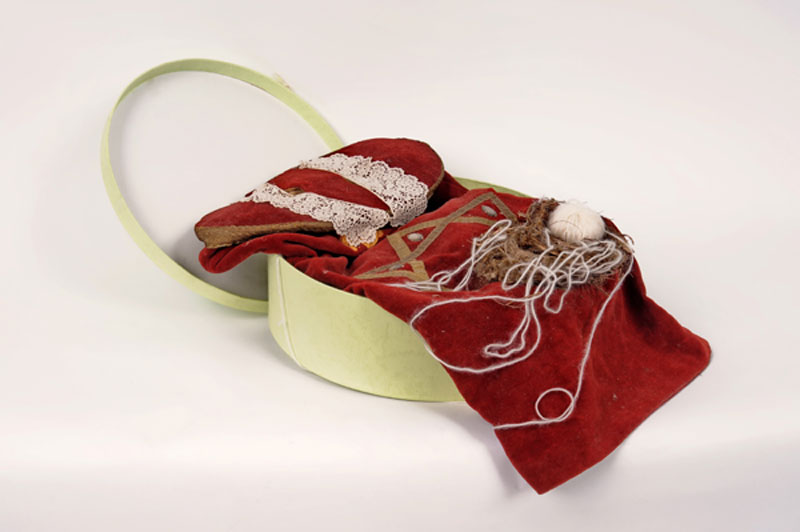
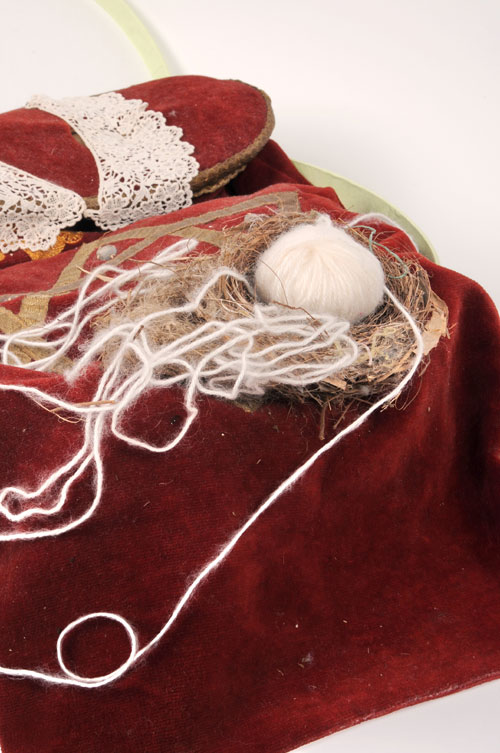
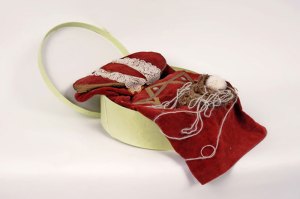
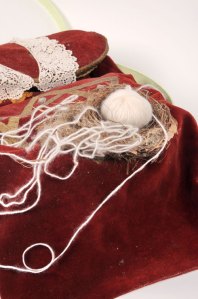
The second piece, Your Mother’s Torah, depicts the Torah mantle with a nest inside, but is also reminiscent of a sewing kit.  Jo describes it as a mother with a fruitful nest.  We might consider using the teachings, mitzvot, stories, and wisdom of Torah to stitch together a Jewish practice and a Jewish home that is comforting and nurturing.  That home – not the synagogue! – is the primary means by which we transmit the values of Torah to the next generation.
Your Mother's Torah - closeup

Out of the Mouths of Babes

The third piece is a Torah mounted on a baby stroller – Out of the Mouths of Babes.  Like the children in the hagaddah, we teach Torah through engaging with questions.  No question is out of bounds – and sometimes the most innocent questions are the most challenging and searching.

Counterparts

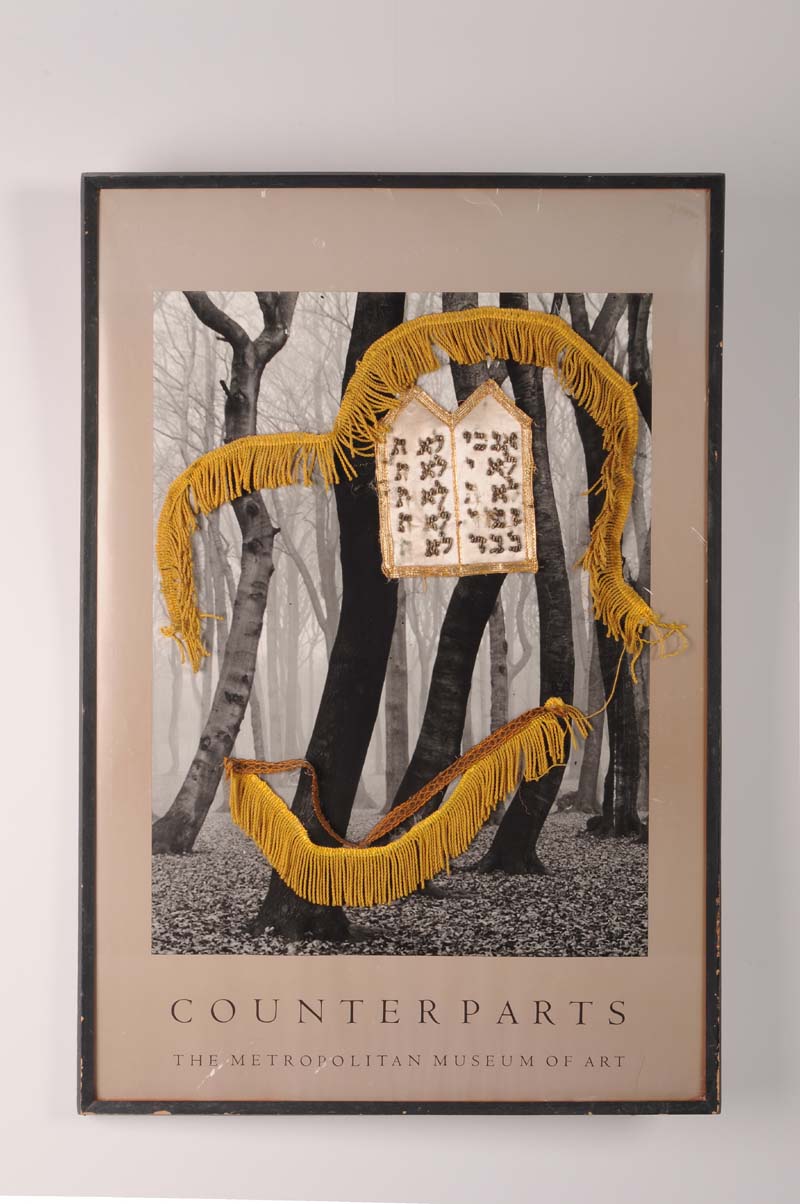
The fourth piece is a poster from the Metropolitan Museum with part of a Torah Mantle mounted on  it.  Entitled Counterparts, Jo writes that “the figural trees in the poster invited the association with Torah as Tree of Life.”
Safety in Torah

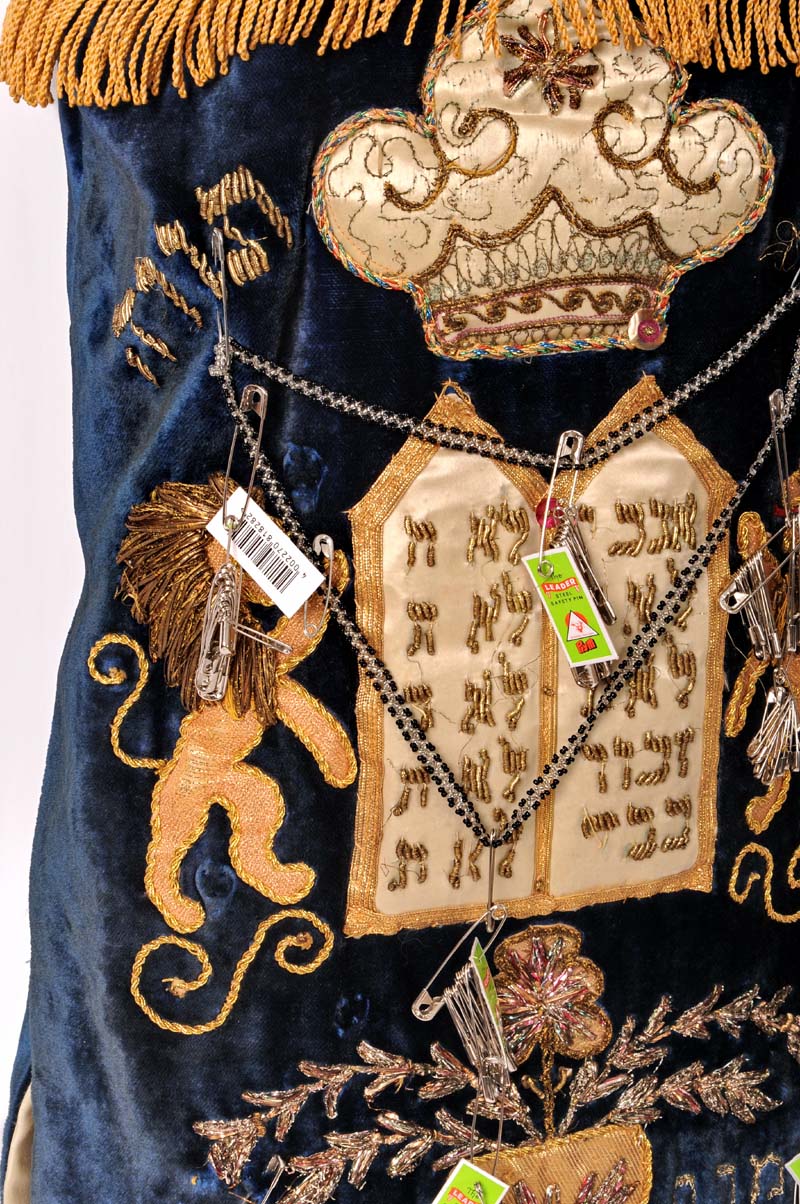
Finally, the last piece is entitled Safety in Torah — what could be safer than safety pins!  It reminds me of the joke — “What do you call a Torah with a seat belt?   A Safer Torah!”  The pun requires a little knowledge of Hebrew (the word sefer, meaning book or scroll).  The piece also alludes to the notion associated with the mezuzah, representing a mini Torah scroll, that the name of God written on the Mezuzah container (Shaddai, the Almighty) stands for the phrase shomer d’latot Yisrael, guardian of the doors of Israel.  While I do not believe that either the Torah or the Mezuzah function in any way as protective amulets, there is clear evidence that people who are active in religious communities live happier and healthier lives.

The experience of viewing art is very personal and subjective – the brief comments I have written above are my impressions.  Please feel free to share your own comments and impressions.