Torah Art

Divre Harav/Words from the Rabbi

About 3 1/2 years ago, the Sisterhood completed a project to create new Torah mantles.  At the same time, we cleaned out one of the back rooms in which we had stored a number of old Torah mantels.  Judy Joseph took some of them, along with an unused Parokhet (curtain) for the Ark, and made a set of wall hangings for the Sanctuary wall.  We offered the rest to donate to congregations in need.  Most of them, however, were unclaimed.  We were on the verge of discarding them by burying them in our cemetery, when I found an artist in Jerusalem, Jo Milgrom, who turns discarded objects (often of Judaica) into Midrash art.   Her pieces are sometimes whimsical, sometimes serious, sometimes poignant, and always thoughtful.  You can see her catalog on her web site, jomilgrom.com.

Jo sent me pictures and brief comments about five pieces that she created from our Torah mantles.  As we approach the holiday of Shavuot, celebrated May 18-20, we might consider what these pieces say to us about Torah.

Found and Lost and Found Again

The first piece, entitled Found and Lost and Found Again, is made of Torah mantles and a Torah reading table cover on a luggage carrier.  The Jew in the Diaspora maintains his or her identity despite wandering and exile and the ultra-mobile society in which we currently live by carrying around small symbols of Torah.  A mezuzah; a seder plate; a hanukkiah; a tallit; tefillin; a siddur or humash.  What have you carried with you during your lifetime, from one home to the next, that roots you in Torah?

Your Mother's Torah

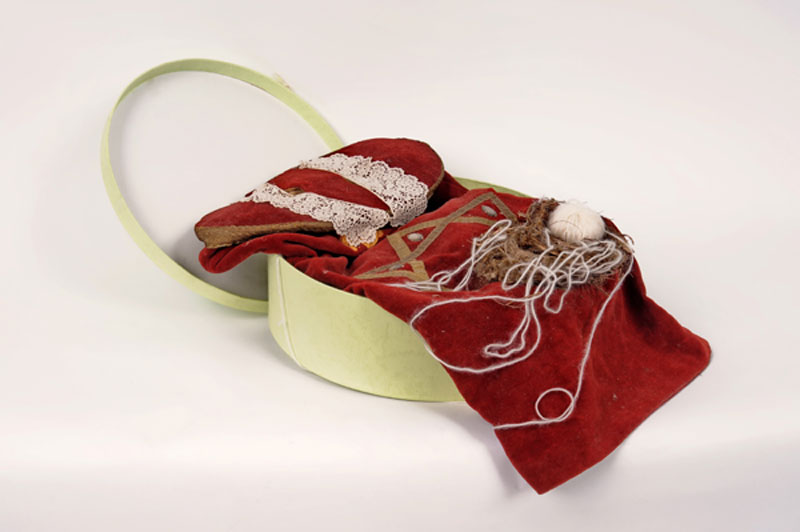
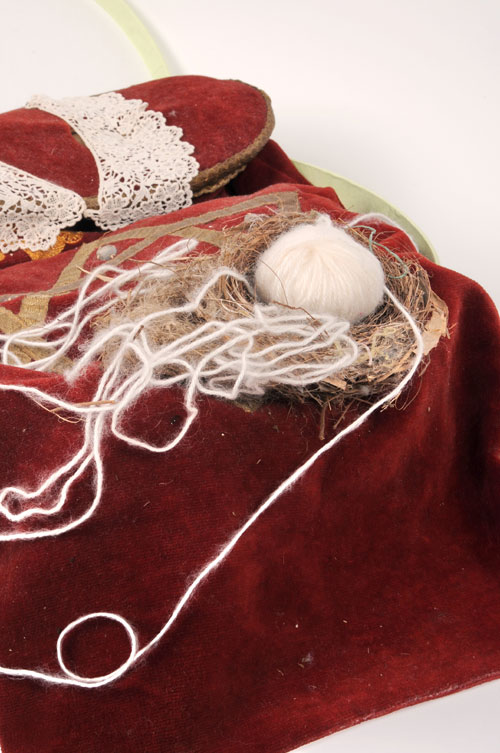
The second piece, Your Mother’s Torah, depicts the Torah mantle with a nest inside, but is also reminiscent of a sewing kit.  Jo describes it as a mother with a fruitful nest.  We might consider using the teachings, mitzvot, stories, and wisdom of Torah to stitch together a Jewish practice and a Jewish home that is comforting and nurturing.  That home – not the synagogue! – is the primary means by which we transmit the values of Torah to the next generation.

Your Mother's Torah - closeup

Out of the Mouths of Babes

The third piece is a Torah mounted on a baby stroller – Out of the Mouths of Babes.  Like the children in the hagaddah, we teach Torah through engaging with questions.  No question is out of bounds – and sometimes the most innocent questions are the most challenging and searching.

Counterparts

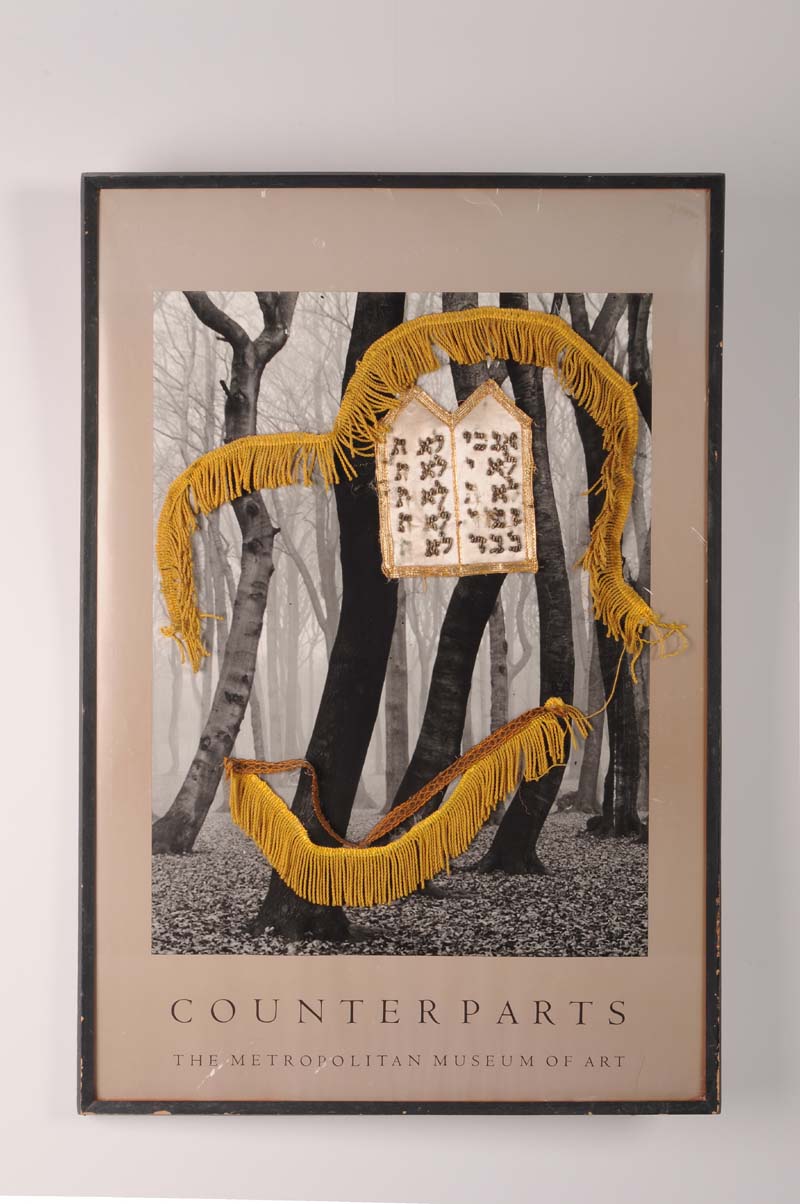
The fourth piece is a poster from the Metropolitan Museum with part of a Torah Mantle mounted on  it.  Entitled Counterparts, Jo writes that “the figural trees in the poster invited the association with Torah as Tree of Life.”

Safety in Torah

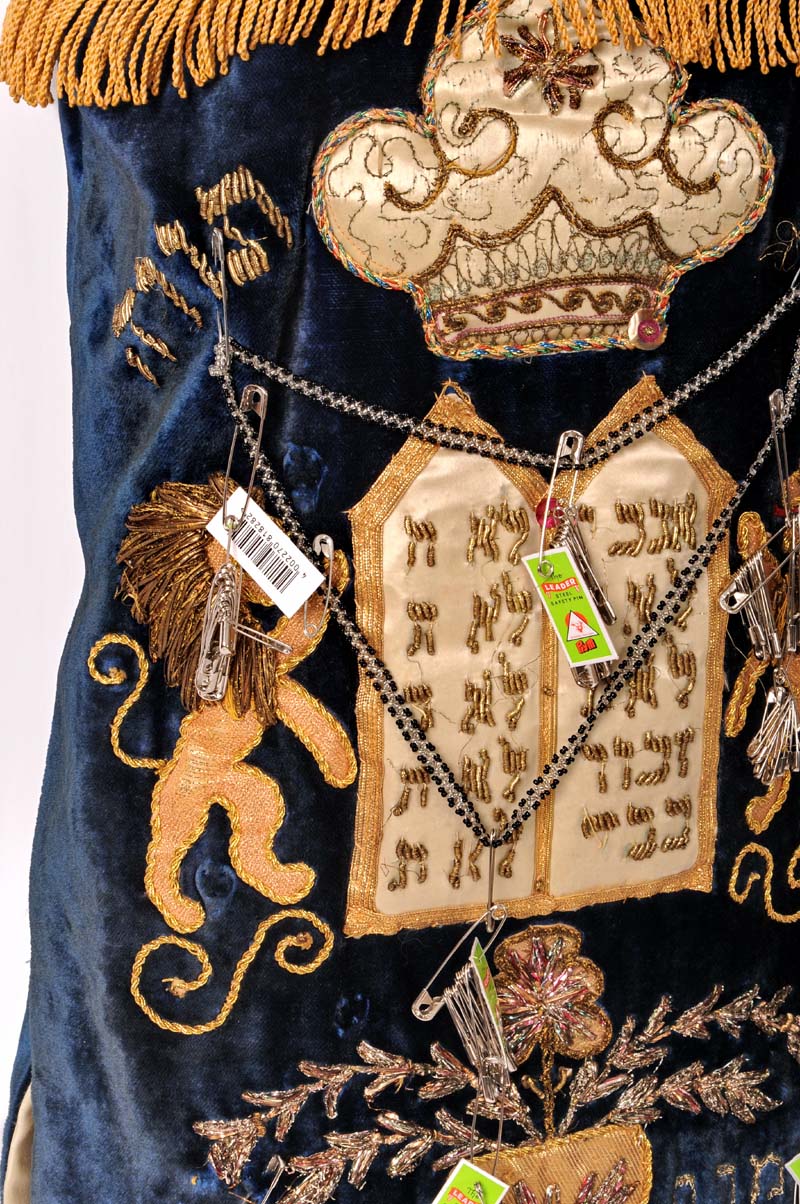
Finally, the last piece is entitled Safety in Torah — what could be safer than safety pins!  It reminds me of the joke — “What do you call a Torah with a seat belt?   A Safer Torah!”  The pun requires a little knowledge of Hebrew (the word sefer, meaning book or scroll).  The piece also alludes to the notion associated with the mezuzah, representing a mini Torah scroll, that the name of God written on the Mezuzah container (Shaddai, the Almighty) stands for the phrase shomer d’latot Yisrael, guardian of the doors of Israel.  While I do not believe that either the Torah or the Mezuzah function in any way as protective amulets, there is clear evidence that people who are active in religious communities live happier and healthier lives.

The experience of viewing art is very personal and subjective – the brief comments I have written above are my impressions.  Please feel free to share your own comments and impressions.

A Walker Among Those Who Stand

Leviticus 18:4 teaches:  “You shall observe my rules, and keep my laws, to walk in them, I am YHVH [your God].”

Our job, according to Leviticus 18:4 is to walk in God’s rules and laws.  We are supposed to be walkers and movers, as in Zachariah 3:7:

Thus said YHVH of Hosts: If you walk in My paths and keep My charge, you in turn will rule My House and guard My courts, and I will make you walkers among those standing there.

There are many people who are just “standing there;” who live their lives inside a narrow box, always doing the same things, eating the same foods, watching the same types of movies and television program, reading the same kinds of books.  You know the type – they are the kind of people who run away from change.  When they have the chance to do something different, they avoid it at all costs.  They like the way things are right now – change, by definition, is negative and to be avoided.  Is this such a bad thing?  Halakha doesn’t change, does it?  Keeping kosher, reciting the Shema, praying regularly, wearing tefillin and giving tzedakah every day (except Shabbat) – all of this is a routine mandated by God’s laws and rules.  Standing firm on God’s laws without compromise is a good thing, right?

Right, except it seems to be better to be a walker than a stander.  So who are the walkers?  What do they do?  The Hasidic Rabbi Moshe Chaim Efrayim, author of the Degel Mahaneh Ephraim, taught:

All that we do – in Torah study, in prayer, in keeping the mitzvot and doing good deeds – is directed toward raising up the Shekhinah to unite her with Her Husband.

A person is called a “walker (holekh),” for people are constantly moving from one spiritual stage to another, either diminishing in capacity, or increasing in awareness each day upward and upward. This is the intent of our verse, “You shall observe my rules, and keep my laws, to walk in them” from stage to stage (level to level), all with the focus of “I am YHVH.”

Walkers are also people who devote themselves to Jewish practices, to mitzvot, just like standers.  The walkers, however, are open to learning to do things differently.  Not abandoning traditional practices necessarily, but finding new and meaningful ways to enhance those practices.

Kashrut, for example, is all about eating kosher food — but it could also be about eating healthy food, grown in sustainable, cruielty-free ways?   It could also be about the ethics of food production.

Walkers occasionally stumble.  Not every movement is going to be up the spiritual ladder towards increasing awareness.  Some movements are going to be downward, spiritually deflating.  But in order to reach the highest possible elevation, we need to risk the occasional falls.  Rabbi Moshe Chaim Ephraim concludes his lesson in good mystical fashion:

That is, we are to join and unite “I (ani)” – another name for the Shekhinah (the Divine Presence) – with “YHVH.” This is the combination of HVY”H (that is, YHW”H) and ADN”Y, the unification of the blessed Holy One and His Shekhinah.

Rather than focus solely on the mechanics of a mitzvah, the mystical tradition encourages us to focus on the goal of the mitzvah — to unite God’s presence down here on earth with the Infinite and unknowable mysterious Holy One, of Blessing.  He encourages us to be open to new paths towards the recognition and enactment of God’s unity.  He asks us to use God’s rules and laws, to direct all of our Torah study, prayers, mitzvot, and good deeds towards the union of the Shekhinah and the Kadosh Barukh Hu.

R. Moshe Chaim Efrayim of Sudylkov is the grandson of the Baal Shem Tov, the founder of Hasidism.  He was born in 1742 or 1748 and died in 1800, on the eve of Lag Ba’omer (this year, his yahrtzeit will be the coming Shabbat).

Eating Animals – Jonathan Safran Foer

Keeping kosher is expensive.  We pay a premium for kosher meat.  No doubt our parents’ or grandparents’ generation paid more for kosher than non-kosher meat, but it seems like the relative difference between kosher and non-kosher meat is much higher now than it used to be.

I have always thought that the reason for this difference can be attributed to two factors:

  • • the move to a standard of Glatt kosher, and
  • • the fact that the soaking and salting of the meat is done by the processing plant rather than by the purchaser

I suspect that consumers are not complaining about paying a little bit more to avoid having to soak and salt the meat themselves, a somewhat lengthy process intended to draw the blood out of of the flesh.

The glatt standard, however, was intended to be a premium standard of kashrut, for those few who could afford the higher prices.  Glatt is a Yiddish word meaning smooth – it refers to the lungs of large animals.  If the lungs have small removable adhesions, and the lungs themselves have no punctures, the animal is kosher, but not glatt.  I have read estimates of the number of animals kosher slaughtered who were found to be glatt ranging from a low of 20% to a high of 60%.  Realize what this means … 40 – 80% of animals who have gone through the kosher slaughter process need to be sent to a non-kosher meat distributor.  This alone significantly raises the price of kosher meat.

However, the glatt standard only affects the price of beef.  The lungs of chickens and turkeys are not inspected for adhesions.  Yet, the relative price of kosher poultry has risen just as much as the relative price of kosher beef.

After reading the book Eating Animals, by Jonathan Safran Foer, I am wondering if there is another reason that kosher meat is so much more expensive than non-kosher meat.

Foer makes a devastating case against factory farming methods of raising chickens and turkeys (and pigs!), as well as the meat slaughtering industry.  There are virtually no “family farms” raising poultry for consumer consumption, although most cattle ranches still raise the animals naturally and humanely.  Factory farms breed animals for a narrow set of physical characteristics aimed at producing the greatest amount of meat, artificially manipulate the environment to grow the animals as quickly as possible, and feed the animals massive amounts of antibiotics to compensate for unnaturally crowded living conditions.  Factory farmed animals are have large numbers of physical defects, are generally unhealthy, and methods of handling and transport result in a large percentage of broken bones and sores.  Their is no way to effectively dispose of all the waste produced by so many animals in such a small space – it is a major source of environmental pollution and probably diseases such as asthma, influenza, and antibiotic resistent strains of infections.

He makes the case that the large poultry producers, such as Perdue and Tyson, have used factory farming techniques to keep the prices artificially low.  The price of poultry has increased at a much slower rate than the price of any other food item.  Meat is the only thing that has become less expensive in the past generation.  This has happened only because in the calculus of how meat is priced, we are ignoring the huge cost of producing factory meat to the environment and to the health care system.

I wonder if kosher meat has actually increased in price in a natural way, rather than having been kept artificially low.

If an animal is diseased; if an animal has broken limbs; if an animal is not killed carefully and properly; it will not be kosher.  While the problems with certain kosher meat slaughter plants are well known, the case that “Eating Animals” makes against the meat industry primarily, though not exclusively, apply to the non-kosher industry.  There is a significant financial disincentive for kosher processors to mistreat the animals.

There is a larger argument in the book, though, that affects both the kosher and non-kosher meat industries.  The argument, quite simply, is that the raising of meat for food is unsustainable.  The very act of killing animals on a large enough scale to satisfy our current desire and expectation for eating meat is dehumanizing.  It cannot be done better, because it is inherently cruel and desensitizes those who engage in slaughter to the horror of the mass killing of animals.  We have destroyed so much of the genetic diversity of chicken, poultry, and pork and we have concentrated so much production is so little space and we have destroyed virtually every small animal farm, that there may be no way to roll back time, change our societal expectation of how much meat should cost, and rebuild an infrastructure of small individually run farms raising animals for slaughter at small, local, processing plants.

Foer writes that the book is not a straightforward case for vegetarianism.  It is much deeper and more complicated.  It explores the relationship between food and memory, animal flesh and forgetting.  It explores the stories we tell about ourselves by the foods we eat and don’t eat.  It explores the words we use and don’t use when speaking about our animal diet.

For vegans, vegetarians, selective vegetarians, selective meat eaters, and proud meat eaters, it is worth reading “Eating Animals.”  I have not even touched on the problems he raises with the fish/seafood industry, the egg industry, or the dairy industry.  Foer does not touch on the problems that corporate farming has raised in the non-meat farms.  The overuse of fertilizers, pesticides, genetic engineering, the reduction of genetic diversity, the patenting of plant species … we really don’t know what effect all of this is going to have on our planet, on our health and the health of the next generation.

Yet Another Embarrassment in the Israeli entanglement of Religion and State

Jewish tradition treats the body as a sacred vessel for the soul.  After death, the body is treated with the same respect as when it was alive.  It is carefully washed and dressed before burial.  Burial takes place as soon as possible – it is not respectful to leave the body unburied.  Autopsies are not permitted, unless doing so will directly save the life of another identified person.  Mutilating the body for the purposes of profit, experimentation, or education is not permitted.

Yet, it is widely accepted that halakha permits organ donation, even in the Orthodox world.  The Conservative movement believes that signing on organ donor card is a positive mitzvah – an obligation.  You can read a teshuvah on the topic here.

Organ donation, however, generally requires accepting the cessation of brain activity as a criteria for death, rather than heart death.  The reason is simple and obvious.  It is generally considered to be the case that once the heart stops beating long enough to pronounce the patient dead, the organs have been deprived of oxygen long enough no longer to be suitable for transplantation.  I have read some material suggesting that in some cases, a criteria of non-heart beat for a period of less than 5 minutes might be enough to declare death and harvest organs, but this is controversial.

Nevertheless, many Jews believe that organ donation is not permitted – that a body must be buried completely intact in order to be resurrected in the messianic era.  My response to this is if God could create my body from joining together two cells, then God can recreate my body even if it is missing a few organs!

Consequently, the rate of organ donation in Israel is embarrassingly low.  Only 8-10% of Israelis are registered as organ donors, compared with an average of 35% in other Western countries.  The Knesset has passed a law giving those who agree to be a donor a higher priority if ever they should need an organ.  The deputy health minister, however, is a follower of Haridi rabbi Yosef Shalom Elyashiv, who does not believe in a brain death criteria.  His followers are not allowed to donate organs.  They are, however, allowed to accept donated organs (is this the definition of hypocrasy, or what?)!  The deputy health minister is apparently going to refuse to implement the new law because he and the rest of the 100,000 followers of Elyashiv would be bumped to the bottom of the organ queue.  You can read stories about the law below.

http://www.tabletmag.com/scroll/28295/israeli-organ-policy-may-be-d-o-a/

Israeli Organ Policy May Be D.O.A.

Innovative idea could discriminate against sect

BY MARC TRACY | 4:21 pm Mar 15, 2010 |

n an effort to raise its quite low 10 percent organ-donor rate, Israel has been planning to give those who agree to be donors a leg up when it comes to receiving organ donations. They would move up in the queue, in other words, should it ever come to that.

While bioethicists say this is perfectly kosher—“reciprocal altruism” is the apparently not-oxymoronic term—the plan has come under fire for allegedly discriminating against some ultra-Orthodox Jews who believe they are religiously barred from being donors. (Never mind that they’re not, assuming the organs are being used to save a life and not for profit.) Specifically, Rabbi Yosef Sholom Elyashiv’s 100,000 Israeli followers believe they are not allowed to donate their organs until after cardiac death (at which point the organs are dead, too). In case you were wondering, yes, they are allowed to accept donated organs.

The Knesset has passed a law enacting this whole thing. Implementation, however, is up to the health minister … there is no health minister currently, so instead it is up to the deputy health minister … the deputy health minister is—of course—an Elyashiv follower. So, we’ll see.

Does Radical New Way To Boost Organ Donation Discriminate Against Ultra-Orthodox Jews? [AP/Vos Iz Neias?]
Earlier: Israel’s New Organ Donor Policies

Tattooing and Body Piercing

I have been teaching my 7th grade class about Jewish ideas of body and soul for the past month.  I entitled the class “Our Body and Our Selves:  Owning vs. Renting.”

One of the most interesting places that this idea plays itself out is in the arena of body art — tattooing and body piercing.

If we own our bodies, we should be able to do with it what we want:  color the skin,and pierce the skin and hang decorations wherever we want.  When we own a house, we are permitted to make whatever renovations we want without any restrictions.

However, if we are only “rentors,” temporary inhabitants of our bodies, it would make sense that the LandLord wouldn’t want us to paint the walls crazy colors.  It would also make sense that we shouldn’t be allowed to put nails in the walls and hang pictures all over the place in haphazard ways.

I’m sure most parents would be happy if it were in fact the case that they could tell their children that the Torah forbids tattooing and piercing.  However, that turns out not to be the case.  The prohibition against tattoos is reasonably explicit (Leviticus 19:28), but equally explicit verses about piercings in the ear and nose (Exodus 21:6, Genesis 24:47, Exodus 32:2) as well as Rabbinic references to women and men with pierced ears make it clear that body piecing is permitted!  Further, there is no compelling argument to permit ear and nose piercing while prohibiting eyebrow, belly button, or other skin piercing.

Rabbi Alan Lucas has written a fascinating teshuvah on the topic, which I will be teaching at an adult education series beginning April 18.  In the meantime, feel free to read Rabbi Lucas’ teshuvah here.