Yom Yerushalayim, Jerusalem Day

Today is the 43rd anniversary of the reunification of Jerusalem in 1967.  The following link gives me chills – it’s the actually news footage of the Israeli army going to the Kotel, the Western Wall and the Temple Mount.  The first link contains a complete transcript and translation.  The button on that page that is supposed to play the audio doesn’t work on my Mac (Safari or Firefox) system.  However, the second link contains an embedded youtube video of the same material.

http://www.isracast.com/article.aspx?ID=374&t=Liberation-of-the-Temple-Mount-and-Western-Wall

http://www.isracast.com/issue.aspx?ID=10&t=Jerusalem_Day

Hello, Wilbur

To add to the conversation about Eating Animals …

Hello, Wilbur

Hello, Wilbur

If we love adorable animals in children’s books, are we ethically obliged to raise our kids vegetarian?

BY MARJORIE INGALL | 7:00 am May 10, 2010

CREDIT: Nickolas Murray, George Eastman House Photography Collection

In the current issue of The Horn Book, the venerable magazine about children’s literature, there’s an essay [1] by children’s-book author Jennifer Armstrong [2] called “Eating Reading Animals.” Armstrong points out that of the all-time bestselling children’s books, fully a third feature animal protagonists. We love to read about our furry and feathered friends. We immerse our kids in animal-centric educational and caretaking experiences. We take them to zoos and farms and encourage them to lavish love and care upon our kitties and doggies. We tie our explanations of global warming and deforestation to how these phenomena endanger adorable fauna. Animal talk is central to the ethical lessons we try to impart to our kids.

And, Armstrong writes, just as we no longer burn live cats or engage in bear-baiting [3] for amusement the way fun-loving Westerners did centuries ago, we need to continue to evolve as moral people. Which is why it’s time to stop eating meat. “[W]hat I am suggesting is that if you love children’s literature, you cannot kill animals just because they taste good on a bun,” she writes. “There’s more than a bit of hypocrisy involved in urging children to empathize with pandas and polar bears and bunnies and ducks in books and at a distance and then feeding them hamburgers and sliced deli meats. The United States kills approximately ten billion land animals every year for human consumption, which works out to over one million animals per hour. No number of books about runaway bunnies, or ducklings negotiating Boston traffic, or terrific and radiant pigs can compensate for that scale of violence, in my opinion.” Her best line: “What is [a child] to make of the trusted adult who holds in one hand a living baby chick to caress with tender care and a chicken nugget in the other hand to eat with special sauce?”

It’s a valid question, even for those of us who nix the nugget because McDonald’s isn’t kosher. Meat is still part of the American Jewish family experience—Shabbat dinner often still revolves around the roast beast; the Jewish deli, while disappearing, still holds iconic cultural pride of place.

Some Jewish writers [4] have recently considered the moral issues around what we ingest. Sadly, as we all know, kashrut isn’t always synonymous with eating morally—look at Postville and the way the Rubashkins’ plant [5] treated animals and workers. I’m involved in a kosher, ethical meat co-op and have followed with interest the attempts by Conservative and Modern Orthodox activists to certify kosher meat as ethical as well as “kosher” according to the letter of halakhah, Jewish law. Ethical kashrut should involve respect for humans and animals. I don’t eat much meat—I joke that I’m in a mixed marriage because I married a Reform Jew from Wisconsin who lives for bratwurst and owns a “Bacon is a Vegetable [6]” t-shirt—but when I do eat meat, I need to know its origins and trust the source. My standards of kashrut wouldn’t be acceptable to some other Jews, and my standards of what’s ethical wouldn’t meet those of vegetarians or vegans. We all have our line in the sand.

And that line can shift. The one time as an adult I willfully broke my own standards of kashrut was when I was writing for a travel guide in rural Greece. On a remote island in the late 1980s, a family insisted I come home with them for dinner. They were fishermen. They caught a fresh squid and smashed it against the side of their fishing boat. I felt just as caught as the cephalopod. I thought about having to explain not just kashrut, but what a Jew was. And I decided that their philosophy of philoxenia, kindness to strangers, was more important than my kashrut. Just that time, and just for me.

At that family’s table I stared down that calamari, heart pounding—I’d never had any unkosher seafood before—and slowly brought one of those ring-y things to my mouth.

Holy moly, it was the most delicious thing I had ever tasted.

Thus ended my one and only foray into non-kosher seafood. So, what’s the moral here? That it’s hard to generalize about ethical rightness. We’re often weighing different goods. And of course, for many people kashrut isn’t about morality at all—it’s about following God’s literal word. Attaching Western values to kashrut is specious, according to many Orthodox folk, because kashrut is about obedience, not moral choice.

My kids love the story of me quaking over a plate of squid rings. Josie tends to follow Daddy’s religion (meat is God), and Maxie tends to follow mine (an occasional hot dog, some white meat, but generally not a fan of the fleisch), and they both revel in tales of my anxiety and waffling—welcome to childhood, where parents’ dithering is children’s joy. Both my kids have experienced that classic youthful moment of revelation, drumstick on way to mouth: Wait, you mean chicken is chicken? Both were briefly horrified; both also forgot or compartmentalized. I expect the classic “OMG, I am so going vegan” to happen, on schedule, in the teen years. If at any point they choose to go fully veg, we’ll accommodate. The amount of meat we eat now is a constant, low-level source of tension (Jonathan wants more; I want less), so adding still more thrumming demands to the mix will only add to the merriment.

In any event, for now, despite my family’s love for our kitty Yoyo and for William Steig’s Sylvester and the Magic Pebble [7], we will continue to eat meat. Some more, some less; some only kosher, others wrapped in prosciutto and stuffed with crawfish. But Armstrong’s essay should make us all think, wherever we fall on the fleshtastic and/or kosher end of the spectrum. Where does food come from? How do we refrain from exploitation of workers, animals, resources? How do our consumer choices affect the planet? We should all be sweating a little. That goes for kashrut-keepers who don’t think the conditions in a slaughterhouse matter, or who wish to shove any further questions about this issue under the blood-stained rug [8]; it goes for vegans with easy answers about what everyone else should do; it goes for Michael Pollan, whose seven-word mantra (“Eat food. Not too much. Mostly plants.”) doesn’t allow for class or cultural nuance.

The word “mitzvah” doesn’t actually mean “good deed,” though many people think it does. It actually means “obligation.” And one obligation that comes with having kids is not getting to go for easy answers anymore. Let’s keep reading, and keep asking the questions. It’s a mitzvah.


Article printed from Tablet Magazine: http://www.tabletmag.com

URL to article: http://www.tabletmag.com/life-and-religion/33112/hello-wilbur/

URLs in this post:

[1] an essay: http://www.hbook.com/magazine/articles/2010/may10_armstrong.asp

[2] Jennifer Armstrong: http://www.jennifer-armstrong.com/index.htm

[3] bear-baiting: http://en.wikipedia.org/wiki/Bear-baiting

[4] Jewish writers: http://www.amazon.com/Eating-Animals-Jonathan-Safran-Foer/dp/0316069906/ref=sr_1_1?ie=UTF8&s=books&qid=1273167099&sr=1-1

[5] Rubashkins’ plant: http://forward.com/articles/119184/

[6] Bacon is a Vegetable: http://store.dieselsweeties.com/products/bacon-is-a-vegetable-shirt

[7] Sylvester and the Magic Pebblehttp://www.amazon.com/Sylvester-Magic-Pebble-Aladdin-Picture/dp/0671662694

[8] blood-stained rug: http://forward.com/articles/127824/
Happy Mother’s Day

A bit of Torah in honor of mothers (Kiddushin 31b):

“When Rabbi Joseph heard his mother’s footsteps, he would say: ‘I will arise before the approaching Shekhinah.’

Shekhinah is a reference to the presence of God, coming from Exodus 25:8, “Let them make Me a sanctuary that I may dwell among them.”

Honoring one’s father and mother, the fifth of the ten pronouncements, forms a bridge between the mitzvot between human beings and God and the mitzvot between human beings. The placement of this command reminds us that our parents are potentially our earliest link to God. Similarly, the statement of Rabbi Joseph honors his mother as the one who gave him life and links him to the presence of God.

Let us be thankful to our mothers, those who gave us biological life and/or those who raised us. They gave us life and hopefully taught us something about how to use our life to bring light and goodness into the world.

Thank you to my colleague Rabbi Rob Scheinberg for sharing the source.

Torah Art

Divre Harav/Words from the Rabbi

About 3 1/2 years ago, the Sisterhood completed a project to create new Torah mantles.  At the same time, we cleaned out one of the back rooms in which we had stored a number of old Torah mantels.  Judy Joseph took some of them, along with an unused Parokhet (curtain) for the Ark, and made a set of wall hangings for the Sanctuary wall.  We offered the rest to donate to congregations in need.  Most of them, however, were unclaimed.  We were on the verge of discarding them by burying them in our cemetery, when I found an artist in Jerusalem, Jo Milgrom, who turns discarded objects (often of Judaica) into Midrash art.   Her pieces are sometimes whimsical, sometimes serious, sometimes poignant, and always thoughtful.  You can see her catalog on her web site, jomilgrom.com.

Jo sent me pictures and brief comments about five pieces that she created from our Torah mantles.  As we approach the holiday of Shavuot, celebrated May 18-20, we might consider what these pieces say to us about Torah.

Found and Lost and Found Again

The first piece, entitled Found and Lost and Found Again, is made of Torah mantles and a Torah reading table cover on a luggage carrier.  The Jew in the Diaspora maintains his or her identity despite wandering and exile and the ultra-mobile society in which we currently live by carrying around small symbols of Torah.  A mezuzah; a seder plate; a hanukkiah; a tallit; tefillin; a siddur or humash.  What have you carried with you during your lifetime, from one home to the next, that roots you in Torah?

Your Mother's Torah

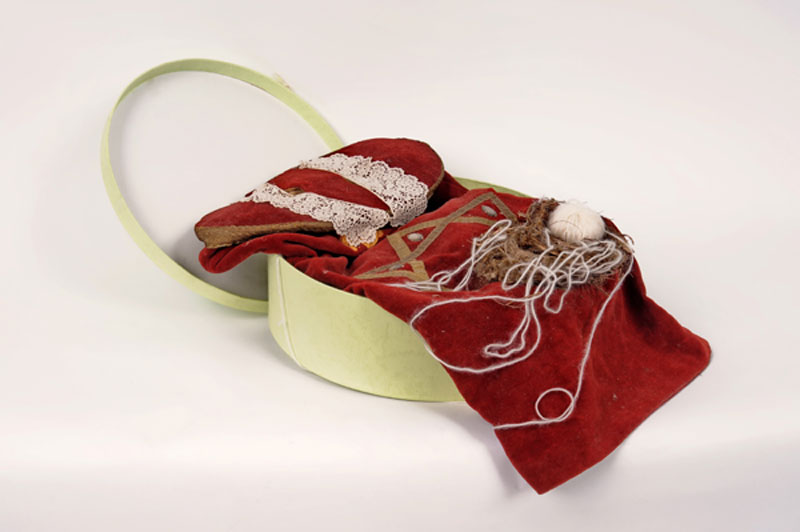
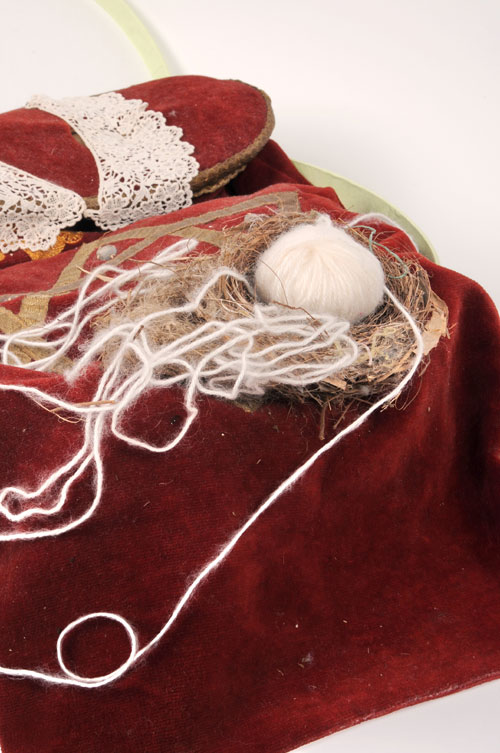
The second piece, Your Mother’s Torah, depicts the Torah mantle with a nest inside, but is also reminiscent of a sewing kit.  Jo describes it as a mother with a fruitful nest.  We might consider using the teachings, mitzvot, stories, and wisdom of Torah to stitch together a Jewish practice and a Jewish home that is comforting and nurturing.  That home – not the synagogue! – is the primary means by which we transmit the values of Torah to the next generation.

Your Mother's Torah - closeup

Out of the Mouths of Babes

The third piece is a Torah mounted on a baby stroller – Out of the Mouths of Babes.  Like the children in the hagaddah, we teach Torah through engaging with questions.  No question is out of bounds – and sometimes the most innocent questions are the most challenging and searching.

Counterparts

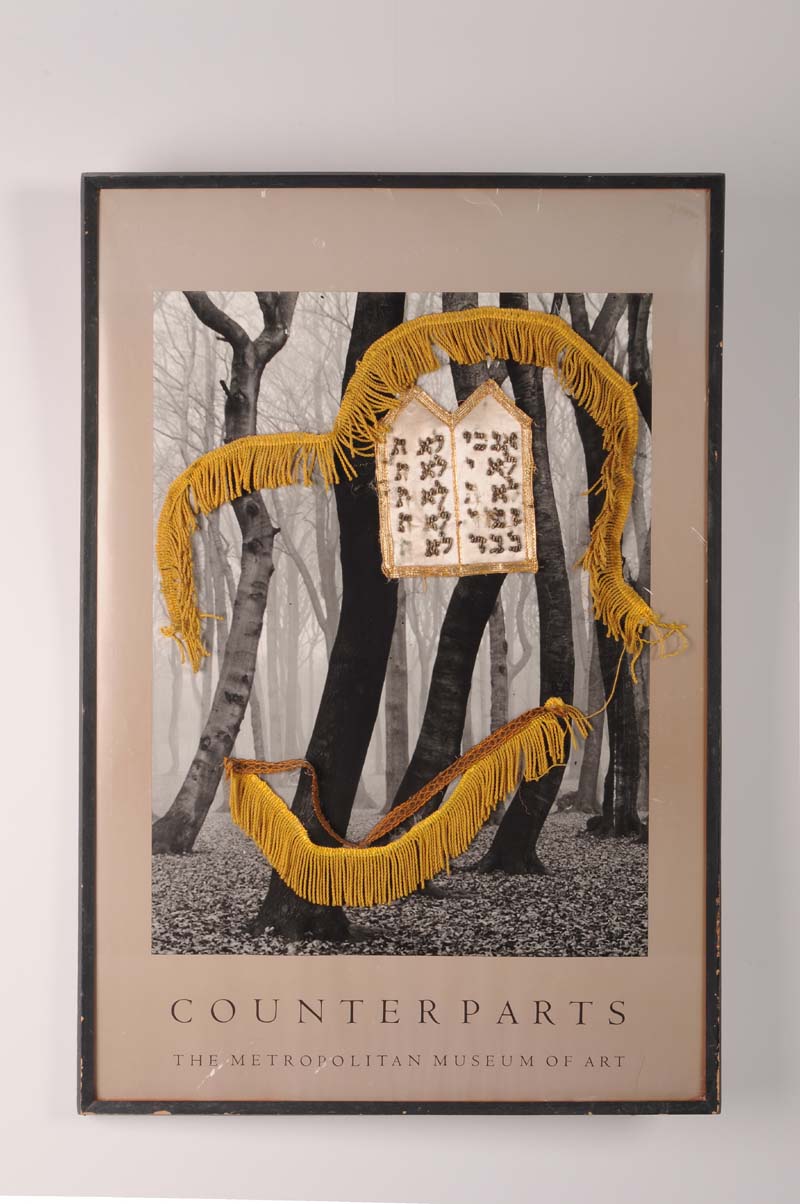
The fourth piece is a poster from the Metropolitan Museum with part of a Torah Mantle mounted on  it.  Entitled Counterparts, Jo writes that “the figural trees in the poster invited the association with Torah as Tree of Life.”

Safety in Torah

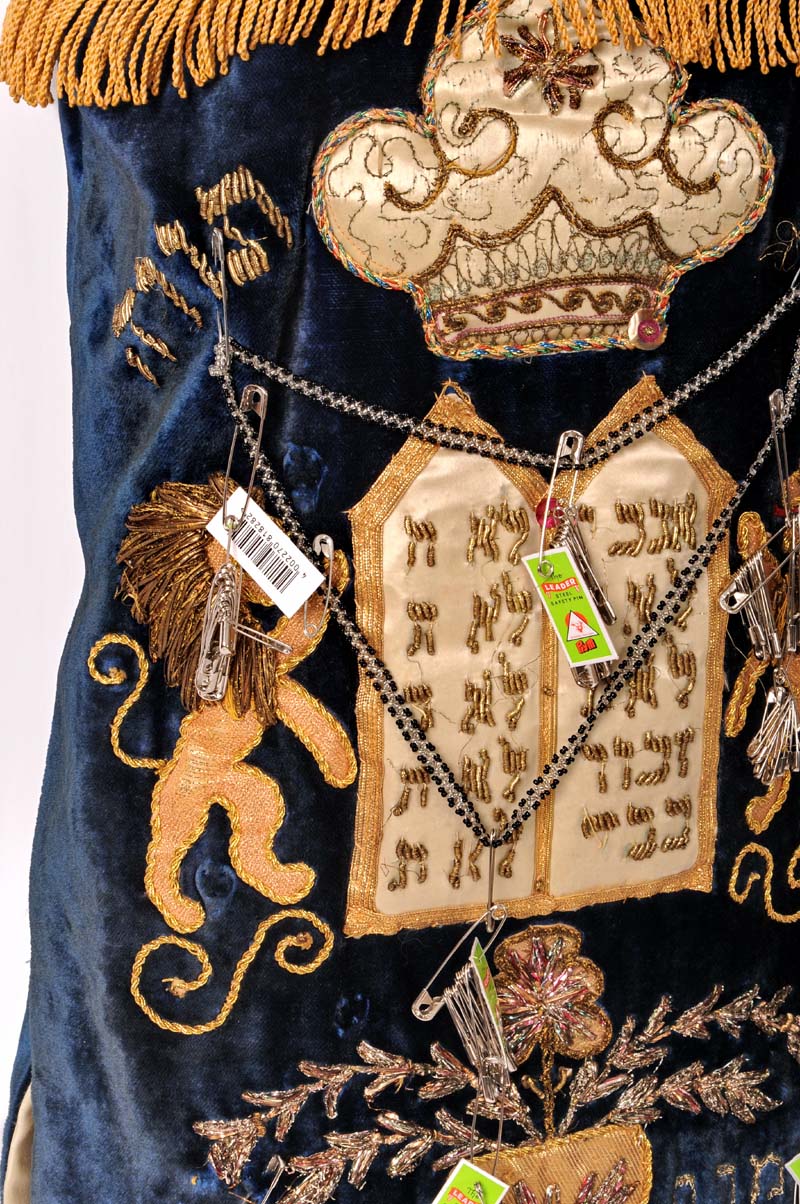
Finally, the last piece is entitled Safety in Torah — what could be safer than safety pins!  It reminds me of the joke — “What do you call a Torah with a seat belt?   A Safer Torah!”  The pun requires a little knowledge of Hebrew (the word sefer, meaning book or scroll).  The piece also alludes to the notion associated with the mezuzah, representing a mini Torah scroll, that the name of God written on the Mezuzah container (Shaddai, the Almighty) stands for the phrase shomer d’latot Yisrael, guardian of the doors of Israel.  While I do not believe that either the Torah or the Mezuzah function in any way as protective amulets, there is clear evidence that people who are active in religious communities live happier and healthier lives.

The experience of viewing art is very personal and subjective – the brief comments I have written above are my impressions.  Please feel free to share your own comments and impressions.

A Walker Among Those Who Stand

Leviticus 18:4 teaches:  “You shall observe my rules, and keep my laws, to walk in them, I am YHVH [your God].”

Our job, according to Leviticus 18:4 is to walk in God’s rules and laws.  We are supposed to be walkers and movers, as in Zachariah 3:7:

Thus said YHVH of Hosts: If you walk in My paths and keep My charge, you in turn will rule My House and guard My courts, and I will make you walkers among those standing there.

There are many people who are just “standing there;” who live their lives inside a narrow box, always doing the same things, eating the same foods, watching the same types of movies and television program, reading the same kinds of books.  You know the type – they are the kind of people who run away from change.  When they have the chance to do something different, they avoid it at all costs.  They like the way things are right now – change, by definition, is negative and to be avoided.  Is this such a bad thing?  Halakha doesn’t change, does it?  Keeping kosher, reciting the Shema, praying regularly, wearing tefillin and giving tzedakah every day (except Shabbat) – all of this is a routine mandated by God’s laws and rules.  Standing firm on God’s laws without compromise is a good thing, right?

Right, except it seems to be better to be a walker than a stander.  So who are the walkers?  What do they do?  The Hasidic Rabbi Moshe Chaim Efrayim, author of the Degel Mahaneh Ephraim, taught:

All that we do – in Torah study, in prayer, in keeping the mitzvot and doing good deeds – is directed toward raising up the Shekhinah to unite her with Her Husband.

A person is called a “walker (holekh),” for people are constantly moving from one spiritual stage to another, either diminishing in capacity, or increasing in awareness each day upward and upward. This is the intent of our verse, “You shall observe my rules, and keep my laws, to walk in them” from stage to stage (level to level), all with the focus of “I am YHVH.”

Walkers are also people who devote themselves to Jewish practices, to mitzvot, just like standers.  The walkers, however, are open to learning to do things differently.  Not abandoning traditional practices necessarily, but finding new and meaningful ways to enhance those practices.

Kashrut, for example, is all about eating kosher food — but it could also be about eating healthy food, grown in sustainable, cruielty-free ways?   It could also be about the ethics of food production.

Walkers occasionally stumble.  Not every movement is going to be up the spiritual ladder towards increasing awareness.  Some movements are going to be downward, spiritually deflating.  But in order to reach the highest possible elevation, we need to risk the occasional falls.  Rabbi Moshe Chaim Ephraim concludes his lesson in good mystical fashion:

That is, we are to join and unite “I (ani)” – another name for the Shekhinah (the Divine Presence) – with “YHVH.” This is the combination of HVY”H (that is, YHW”H) and ADN”Y, the unification of the blessed Holy One and His Shekhinah.

Rather than focus solely on the mechanics of a mitzvah, the mystical tradition encourages us to focus on the goal of the mitzvah — to unite God’s presence down here on earth with the Infinite and unknowable mysterious Holy One, of Blessing.  He encourages us to be open to new paths towards the recognition and enactment of God’s unity.  He asks us to use God’s rules and laws, to direct all of our Torah study, prayers, mitzvot, and good deeds towards the union of the Shekhinah and the Kadosh Barukh Hu.

R. Moshe Chaim Efrayim of Sudylkov is the grandson of the Baal Shem Tov, the founder of Hasidism.  He was born in 1742 or 1748 and died in 1800, on the eve of Lag Ba’omer (this year, his yahrtzeit will be the coming Shabbat).