Sukkot and the Artprize Competition

Divre Harav – November, 2010 – Sukkot and the Artprize Competition

Part of the mission of Congregation Ahavas Israel is to be a resource for people who want to explore a Jewish path to God.   As a congregation, we have presented various educational outreach programs to teach members of the Christian community about Jewish holidays and rituals.   Our Passover Seder Experience has been a very successful outreach program, teaching church communities about the elements of an authentic Seder.  My sense is that most Christians have heard of Hanukkah and Yom Kippur, although they may not really know the significance of the holidays.  However, to most people outside of the Jewish community, Sukkot is completely unknown.  They don’t realize that holiday that their Bible calls the Feast of Tabernacles or Booths is still celebrated by the Jewish community in much the same way as it was thousands of years ago.

This past September, to raise Sukkot awareness, a competition called Sukkah City took place in New York.  Rules were published outlining how to build a Sukkah according to halakha.  Entries were submitted.  Twelve finalists were chosen by a panel of jurors.  The finalists were invited to build and display the sukkot in Union Square Park.  One winner was chosen by popular vote.  Does this remind you of a little competition we held here in Grand Rapids, called Artprize?  The organizers and funders of Sukkah city want to expand the competition to cities around the world next year.

During Sukkot, I, like many of you, enjoyed the Artprize competition.  I enjoyed walking around looking at the variety of pieces of art. At some point it occurred to me that Artprize would be a great opportunity to teach about Sukkot.

I am imagining a Sukkah decorated outside and inside with prose and poetry and pictures about the meaning of the Sukkah, the message of the Sukkah and by extension the message of Judaism.  It would be an exploration of homelessness and insecurity versus permanence and rootedness.  It would explore the roots of the American Thanksgiving, and the growing interest in food production and community supported agriculture.

I am not an artist, an engineer, or a carpenter.  This is not a project that I have the skills to coordinate.  I’m just tossing out the idea to see if anyone is up for designing a Sukkah and entering it into the Artprize competition next year.  I’m envisioning a small committee, sponsored by the synagogue, of a few people to design and build the structure, and a few people to create the messages on the walls.  If this is an idea that appeals to you, please contact me.  I will help you create an ad hoc committee to get started in preparation for next year’s Artprize.

Divre Harav/Words from the Rabbi – October, 2010

Our Sanctuary Shabbat speaker program is entering its fifth year.  We have heard about 50 speakers, and while we have never had a formal description of the parameters of what constitutes a legitimate speaker, I thought I would share with you my own internal guidelines for choosing speakers.
The opportunity to speak at Ahavas Israel is open to any position which does not explicitly contradict a fundamental value of Judaism and the synagogue.  This excludes a speaker on the topic of why we should serve bacon wrapped shrimp at kiddush.  A speaker on an environmental topic, as long as he/she does not advocate wholesale, wanton, purposeless destruction, may agree or disagree with the proposition of human caused global warming and still remain within acceptable boundaries of Jewish values.
Jewish values rarely dictate specific policy.  They instruct us not to be cruel to animals, but leave choice of whether to kill an animal for food up to us.  Thus, I might have a speaker one month urging a vegetarian diet, and another month extolling the role of fur trading Jews in establishing the Jewish community of Michigan, and encouraging us to wear fur shtreimels in their honor.
I have invited Senators Stabenow and Levin, governor Granholm, Judge Steve Pestka, and Representative Ehlers to speak on a Shabbat morning (only Mr. Ehlers and Mr. Pestka accepted the invitation).  I look foreword to inviting our new representative from the 3rd district after the election.  I do not invite politicians actively campaigning for office.
Some speakers are Jewish and have explicitly Jewish messages.  Others are not Jewish, but have Jewish messages.  Still others have messages which are not specifically Jewish (such as domestic abuse) but which I believe are important messages for us to hear.
Part of being a member of a Jewish community is accepting the obligation of learning.  Shabbat is our primary gathering time to study together.  Whatever we have learned, whether it comes from a d’var Torah or a speaker on the topic of kayaking and faith, should both influence and be influenced by our understanding of the Torah reading and by our prayers.
We do not live in a vacuum.  Our world is not defined solely by Torah.  We read books, see movies, watch television, read and watch news from various sources, and interact with a variety of people in the course of an average day.  The sanctuary shabbat speaker series is meant to remind us that our essential Jewish values ought to inform our decision making process.
I realize that this is a pretty lofty set of goals for a simple speaker series.  So far, beginning the fifth year of the sanctuary shabbat speaker program, I have had virtually no trouble finding good speakers on interesting topics (although I acknowledge that some of you might disagree that all speakers have been good and all topics interesting!).  However, I find myself increasingly in need of assistance in finding speakers and topics.  Since we have no budget for the speakers, we only occasionally are able to pay a speaker.  If you know of individuals that would be good speakers or topics that we should address, please share them with me.
Divre Harav/Words from the Rabbi
Our Sanctuary Shabbat speaker program is entering its fifth year.  We have heard about 50 speakers, and while we have never had a formal description of the parameters of what constitutes a legitimate speaker, I thought I would share with you my own internal guidelines for choosing speakers.
The opportunity to speak at Ahavas Israel is open to any position which does not explicitly contradict a fundamental value of Judaism and the synagogue.  This excludes a speaker on the topic of why we should serve bacon wrapped shrimp at kiddush.  A speaker on an environmental topic, as long as he/she does not advocate wholesale, wanton, purposeless destruction, may agree or disagree with the proposition of human caused global warming and still remain within acceptable boundaries of Jewish values.
Jewish values rarely dictate specific policy.  They instruct us not to be cruel to animals, but leave choice of whether to kill an animal for food up to us.  Thus, I might have a speaker one month urging a vegetarian diet, and another month extolling the role of fur trading Jews in establishing the Jewish community of Michigan, and encouraging us to wear fur shtreimels in their honor.
I have invited Senators Stabenow and Levin, governor Granholm, Judge Steve Pestka, and Representative Ehlers to speak on a Shabbat morning (only Mr. Ehlers and Mr. Pestka accepted the invitation).  I look foreword to inviting our new representative from the 3rd district after the election.  I do not invite politicians actively campaigning for office.
Some speakers are Jewish and have explicitly Jewish messages.  Others are not Jewish, but have Jewish messages.  Still others have messages which are not specifically Jewish (such as domestic abuse) but which I believe are important messages for us to hear.
Part of being a member of a Jewish community is accepting the obligation of learning.  Shabbat is our primary gathering time to study together.  Whatever we have learned, whether it comes from a d’var Torah or a speaker on the topic of kayaking and faith, should both influence and be influenced by our understanding of the Torah reading and by our prayers.
We do not live in a vacuum.  Our world is not defined solely by Torah.  We read books, see movies, watch television, read and watch news from various sources, and interact with a variety of people in the course of an average day.  The sanctuary shabbat speaker series is meant to remind us that our essential Jewish values ought to inform our decision making process.
I realize that this is a pretty lofty set of goals for a simple speaker series.  So far, beginning the fifth year of the sanctuary shabbat speaker program, I have had virtually no trouble finding good speakers on interesting topics (although I acknowledge that some of you might disagree that all speakers have been good and all topics interesting!).  However, I find myself increasingly in need of assistance in finding speakers and topics.  Since we have no budget for the speakers, we only occasionally are able to pay a speaker.  If you know of individuals that would be good speakers or topics that we should address, please share them with me.
Men’s and Women’s Spirituality

Divre Harav/Words from the Rabbi – August/September, 2010

During my visit to Camp Ramah earlier this summer, I was dovening with the boys’ cabins of my son’s aidah.  For this minyan, the girls were dovening elsewhere.  Periodically, the staff wanted to give both the boys and girls a single-sex prayer experience.  One of the male counselors asked the boys, “How do you connect with God differently than the girls?  How is boys’ spirituality different than girls?”
The campers mentioned things like praying with tallit and tefillin, and wearing a kippah.  Afterwards, I mentioned to the counselor that the campers who grew up in egalitarian congregations probably couldn’t really relate to the question.  The answers that were given came from non-egalitarian campers who would have thought that girls would never wear kippot, tallit, or tefillin.
I was and continue to be stumped by the question.  Is there any way in which my religious expression is uniquely male?  There is an underlying spirituality in the ritual surrounding athletic experiences, but God blessed me with a body that lacks the size, height, strength, and coordination for team sports (other than chess!). I can’t help thinking about poet Robert Bly’s turn to male drumming circles, but somehow sitting around a fire shirtless beating a drum and being attacked by mosquitoes doesn’t do it for me.
The religious life committee has scheduled a number of women’s Rosh Hodesh gatherings.  Rosh Hodesh, the celebration of a new month, is a religious moment that even in egalitarian congregations continues to be associated with women’s spirituality.  With the demise of the Sisterhood, the Religious Life committee thought that there should continue to be some women-only outlet for religious expression at Ahavas Israel.
The camp experience made me wonder whether there ought to be a male-only religious program as well.  I have never seriously considered such a program, for the simple reason that my own spiritual sense has never indicated a need for a men’s group.  Are there others in our community who would like a periodic male minyan or men’s study group?  I’m sure that the Federation of Jewish Men’s Clubs has resources and materials that would support this kind of group.
If an Ahavas Israel Men’s Spirituality group would be meaningful to you, and if you have a suggestion as to what form it might take, I am open to suggestions.
As we approach the fall holidays, I wish each of you a good new year.  May your prayers flow from your lips with sweetness, and may all of your needs – physical, emotional, and spiritual – be fulfilled.

Divre Harav/Words from the Rabbi – Summer, 2010

One of my projects for the past couple of months has been working with a web designer on our new Ahavas Israel web site.  By the time you read this it should have replaced the web site that Paula Bojsen created for us about five years ago.  Paula created a state of the art web site which over the years has been a valuable virtual front door to the congregation.  It is fascinating to me how quickly time goes by in the internet world.  Five years is a generation.  A five year old web site looks dated, but more importantly, the technology that was used to create and maintain had become obsolete.  We undertook the redesign project in order to ensure that our web site functions not only as an attractive and informational brochure for potential members, but also as a communications tool for our congregational family.

While researching web sites of other synagogues, I found many, belonging to both large and small congregations, that contained broken links and out-of-date information.  As a virtual front door to the congregations, they reflected badly on the organization.  We are grateful to Rachel Lutwick-Deaner for keeping our website updated for the last few years.

One of the interesting things about building a web site is that it is a great equalizer among congregations.  A 2000 family synagogue might have a large building and staff along with an eight figure budget and a multi-million dollar endowment, and might offer a greater variety of programming than a small congregation, but you can put their web site and ours side by side, and the differences shrink.  A large congregation is just as likely to have a difficult to navigate, out of date, web site as a small congregation.

I also found organizations with web sites that gave no sense of the personality of the congregation.  Many Federation and Chabad web sites, which take most of their content from a national organization suffer from this.  Such generic sites may have useful information, but the personality and uniqueness of the local organization is buried underneath the identity of the national parent organization.  In the world of news, we know that national and international news can be found any number of places; local news sources, however, are much more limited in number.  A web site of a congregation should stress the local, not the national.  Our web site reflects the fact that Ahavas Israel exists to provide local community and connections.

Our new web site can be found at the same address, AhavasIsraelGR.org.  Please visit it and let me know what you think.  Let me know what else you’d like to see, and let me know if the organization and layout is intuitive and usable.

Torah Art

Divre Harav/Words from the Rabbi

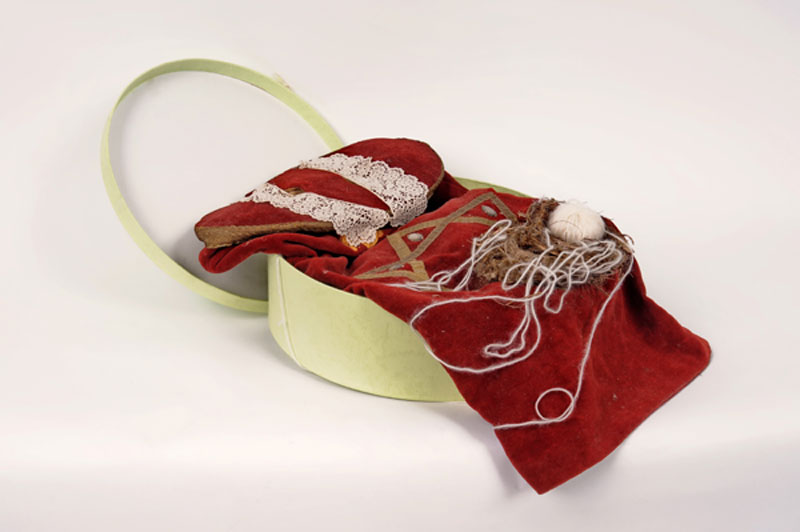
About 3 1/2 years ago, the Sisterhood completed a project to create new Torah mantles.  At the same time, we cleaned out one of the back rooms in which we had stored a number of old Torah mantels.  Judy Joseph took some of them, along with an unused Parokhet (curtain) for the Ark, and made a set of wall hangings for the Sanctuary wall.  We offered the rest to donate to congregations in need.  Most of them, however, were unclaimed.  We were on the verge of discarding them by burying them in our cemetery, when I found an artist in Jerusalem, Jo Milgrom, who turns discarded objects (often of Judaica) into Midrash art.   Her pieces are sometimes whimsical, sometimes serious, sometimes poignant, and always thoughtful.  You can see her catalog on her web site, jomilgrom.com.

Jo sent me pictures and brief comments about five pieces that she created from our Torah mantles.  As we approach the holiday of Shavuot, celebrated May 18-20, we might consider what these pieces say to us about Torah.

Found and Lost and Found Again

The first piece, entitled Found and Lost and Found Again, is made of Torah mantles and a Torah reading table cover on a luggage carrier.  The Jew in the Diaspora maintains his or her identity despite wandering and exile and the ultra-mobile society in which we currently live by carrying around small symbols of Torah.  A mezuzah; a seder plate; a hanukkiah; a tallit; tefillin; a siddur or humash.  What have you carried with you during your lifetime, from one home to the next, that roots you in Torah?

Your Mother's Torah

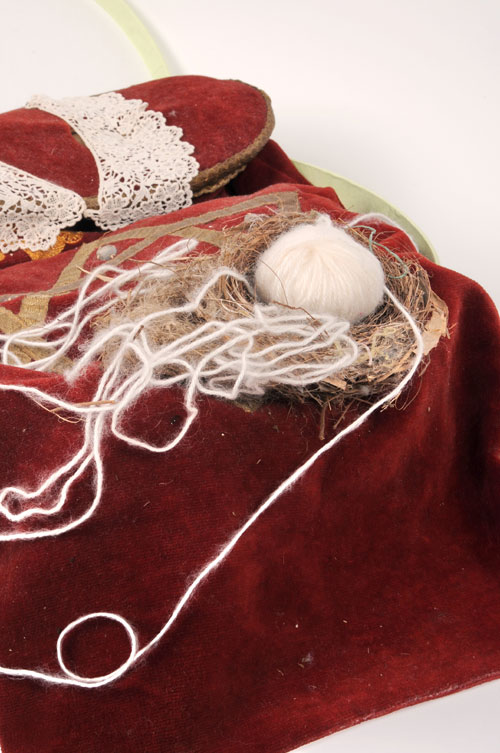
The second piece, Your Mother’s Torah, depicts the Torah mantle with a nest inside, but is also reminiscent of a sewing kit.  Jo describes it as a mother with a fruitful nest.  We might consider using the teachings, mitzvot, stories, and wisdom of Torah to stitch together a Jewish practice and a Jewish home that is comforting and nurturing.  That home – not the synagogue! – is the primary means by which we transmit the values of Torah to the next generation.

Your Mother's Torah - closeup

Out of the Mouths of Babes

The third piece is a Torah mounted on a baby stroller – Out of the Mouths of Babes.  Like the children in the hagaddah, we teach Torah through engaging with questions.  No question is out of bounds – and sometimes the most innocent questions are the most challenging and searching.

Counterparts

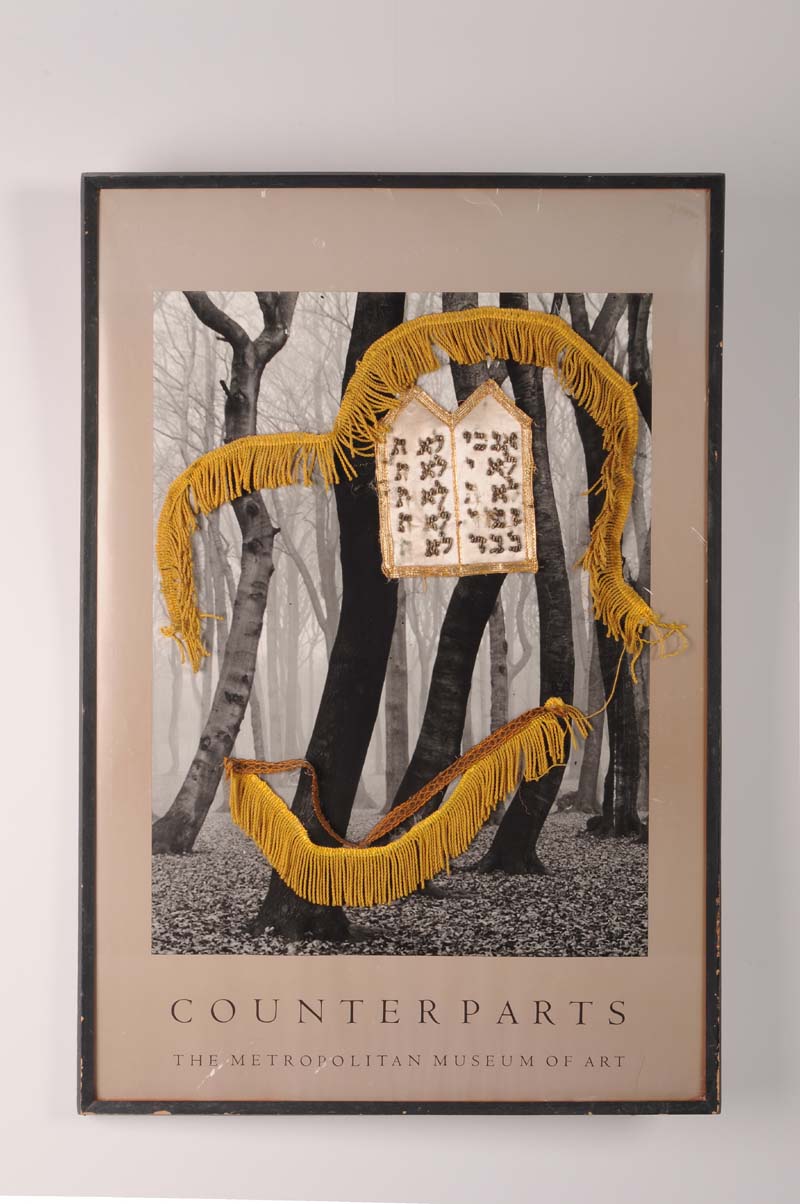
The fourth piece is a poster from the Metropolitan Museum with part of a Torah Mantle mounted on  it.  Entitled Counterparts, Jo writes that “the figural trees in the poster invited the association with Torah as Tree of Life.”

Safety in Torah

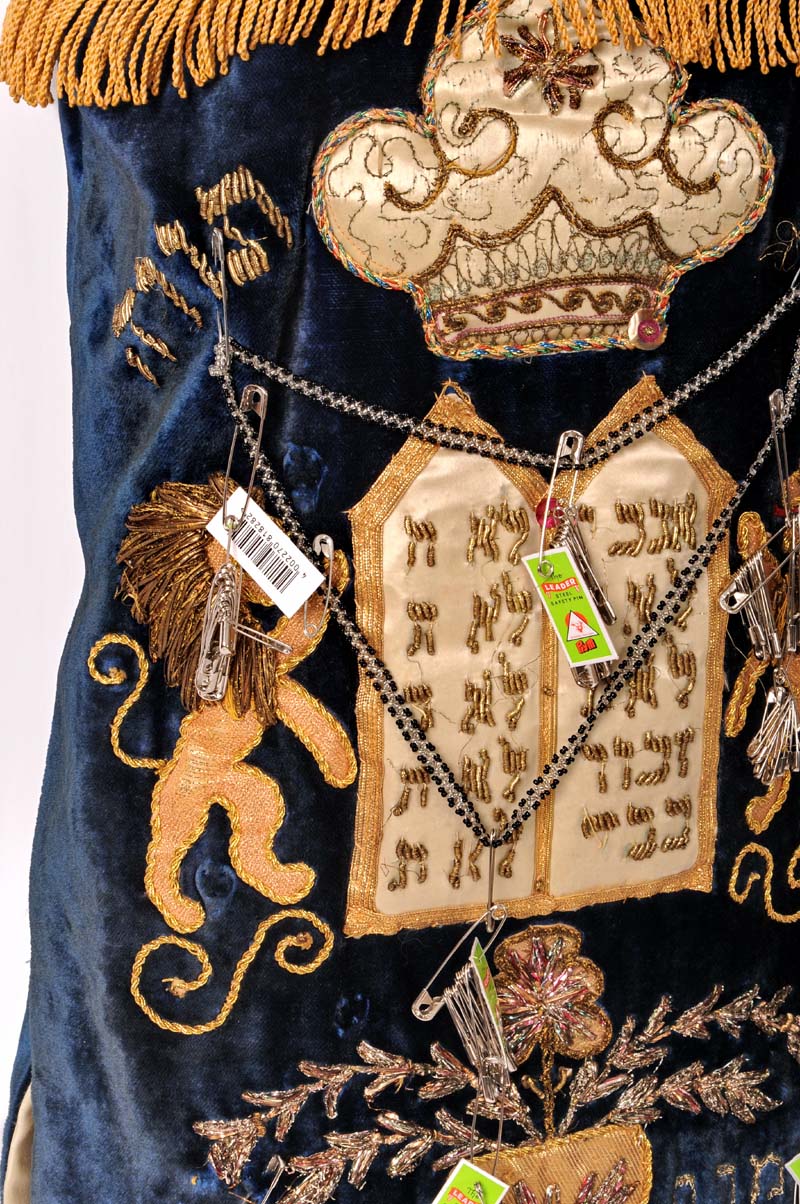
Finally, the last piece is entitled Safety in Torah — what could be safer than safety pins!  It reminds me of the joke — “What do you call a Torah with a seat belt?   A Safer Torah!”  The pun requires a little knowledge of Hebrew (the word sefer, meaning book or scroll).  The piece also alludes to the notion associated with the mezuzah, representing a mini Torah scroll, that the name of God written on the Mezuzah container (Shaddai, the Almighty) stands for the phrase shomer d’latot Yisrael, guardian of the doors of Israel.  While I do not believe that either the Torah or the Mezuzah function in any way as protective amulets, there is clear evidence that people who are active in religious communities live happier and healthier lives.

The experience of viewing art is very personal and subjective – the brief comments I have written above are my impressions.  Please feel free to share your own comments and impressions.